
The Mecca Pact: Islamic NATO or Another OIC? An Independent Reading of the Region’s Newest Alliance
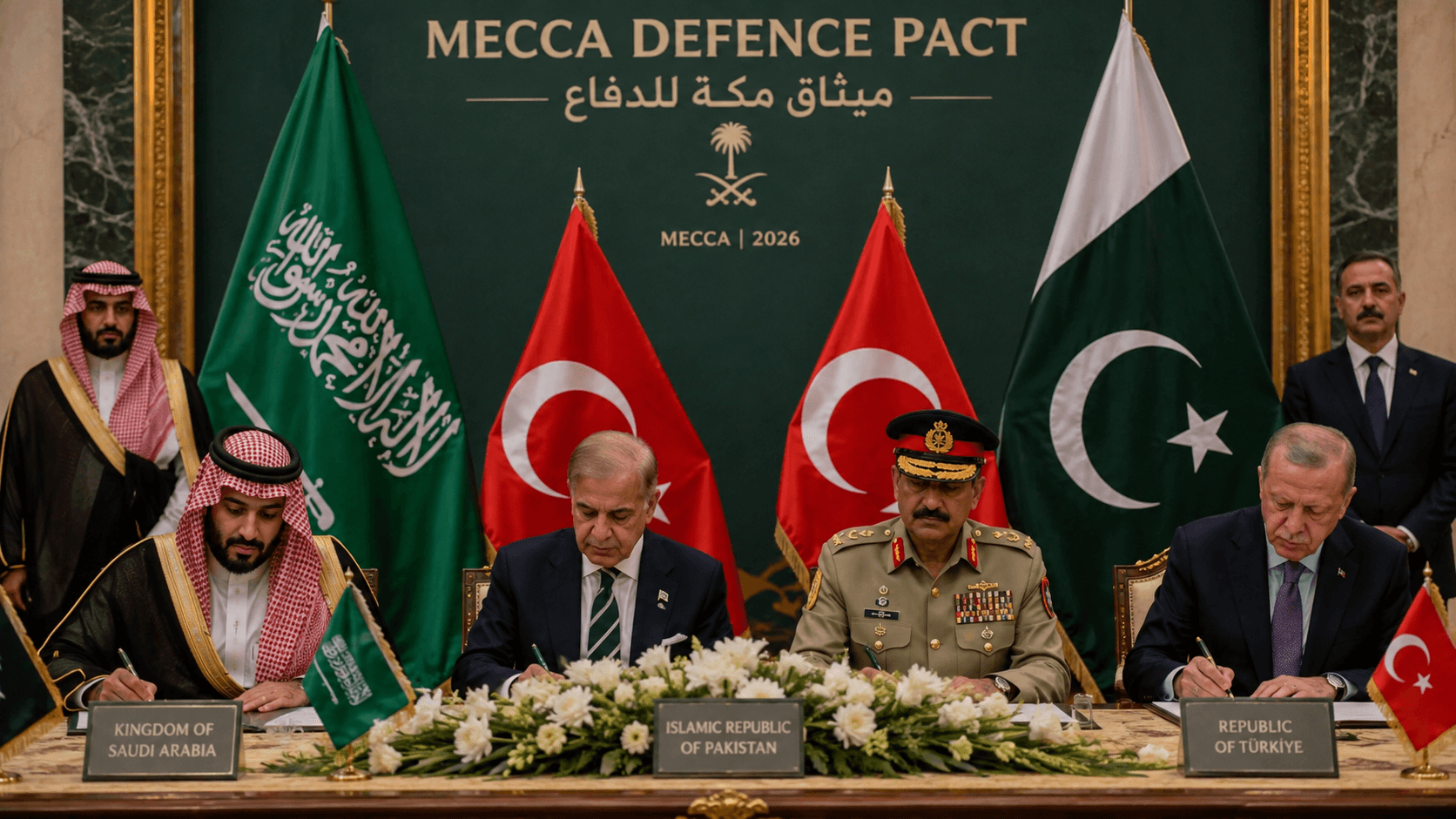
On August 7, 2026, in the city regarded by Muslim pilgrims as the safest place on Earth for fourteen centuries, three countries (Pakistan, Saudi Arabia, and Türkiye) signed an agreement recognizing any attack on one of them as an attack against all of them. This symbolism was intentional. The question is whether the agreement will prove true.
The pact, known as the Makkah Joint Defence Agreement (Mecca Pact), was formulated by Saudi Crown Prince Mohammed bin Salman, Pakistani Prime Minister Shehbaz Sharif, along with Field Marshal Asim Munir, and Turkish President Recep Tayyip Erdogan.
While the term “Islamic NATO” is perhaps a fitting description for the pact due to its similarity with NATO’s Article 5, this comparison does not hold water with respect to any other aspect of the pact. Even though it is easy to see why this comparison can be made, the actual reason it was formulated must be explored further.
Why Now — The Pact Was Born in a War, Not a Vacuum
In terms of context over ritualistic practices: the agreement wasn’t born in calm and reasoned ways — it was signed amidst tumultuous events; the region became engulfed in disputes right from late February 2026, when Iran started to engage in a war against the United States and Israel, leading to retaliatory acts by Iran in other Gulf countries, including Saudi Arabia.
The Strait of Hormuz became one of the hot spots of that war, which also included the revival of the Yemen war, which had been on hold for some time. Even before this event, Pakistan had moved hundreds of thousands of personnel and equipment to Saudi Arabia, following the earlier agreement from September 2025, when Islamabad and Riyadh signed a treaty.
Will It Fail Like the OIC — Or Is It Structurally Different?
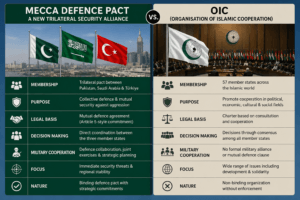
This is the comparison that every doubting reader ought to be thinking about, and it is much more provocative than the NATO analogy. The Organization of Islamic Cooperation has taken more than fifty years to show that common religious affiliation without similar strategic interests results in statements, rather than actions.
Fifty-seven countries make up the Organization, making declarations on Palestine and Kashmir, but rarely taking concrete measures. If the Mecca Pact is merely a new name for the OIC, it will meet the same slow death as a bureaucracy.
But there are real structural differences worth weighing honestly:
1. It’s three actors, not fifty-seven
While smaller coalitions tend to synchronize their operations effectively, larger coalitions generally work efficiently and get results. However, due to its size, the OIC is unable to operate effectively, as it requires consensus among several member countries such as Indonesia, Nigeria, Iran, and other Arab countries, which faces serious obstacles in practice.
2. Each partner brings something the others lack
Saudi Arabia provides cash and oil power. Turkey contributes an extensive domestic defense manufacturing sector — drones, navy vessels, planes — coupled with experience in NATO-standard compatibility. Pakistan brings in a professional army that has been tested in combat and, although it is rarely stated, the only nuclear weapons program in the Islamic world.
3. It was signed during, not before, a shooting war
Alliances that have stood the test of battle become strong, established institutions. Whereas peacetime alliances lose significance the minute the perceived danger lessens. Confusingly, the Houthi attack on the Saudi Aramco refinery in Jizan, which happened less than two days after the signing, was essentially the first crisis that the agreement survived, even though there was no military response.
The warning by several regional analysts about Pakistan’s increasing involvement in conflicts that do not originate from it makes sense, as it indicates the fact that strategic importance can convert into strategic entrapment.
The Honest Weaknesses Nobody in Mecca Was Going to Advertise
- There is no unified command or shared nuclear umbrella available. Despite this rhetoric about “an attack on one is an attack on all,” Pakistan’s nuclear deterrent is not believed to extend to Turkey or Saudi Arabia. For 40 years, Pakistan’s nuclear capabilities were oriented toward India, and it shows no indication of changing that. So the key treaty provision is simply symbolic in its nuclear aspect.
- The countries do not agree on a regional order. Turkey’s activities in Syria or Libya and the Eastern Mediterranean are not always compatible with those of Saudi Arabia, which is considerably more cautious and favorable to the status quo. Although the treaty seems to be closing this gap, such an agreement will turn out to be ineffective once a real crisis arises.
- Pakistan is at risk of fighting someone else’s wars due to its complicated ties with Iran and Saudi Arabia. If Saudi Arabia or Turkey gets involved in a greater confrontation with Iran or Israel, Pakistan might need to get involved in military operations irrelevant to its national interests, which is what usually happens to many small countries in the great power alliance.
- No public text of the treaty has been obtained yet. At this point, the parts of the treaty remain unpublished. Instead of the full treaty text, the governments are communicating the treaty via press releases. It is up to you to decide whether the ambiguity is a sign of cleverness on the part of the governments or just a sign of a potentially dysfunctional treaty.
Comparing the Architecture: OIC vs. NATO vs. the Mecca Pact
| Feature | OIC | NATO | Mecca Pact |
|---|---|---|---|
| Membership size | 57 states | 32 states | 3 states (open to more) |
| Basis of unity | Religious identity | Shared threat + shared values | Shared immediate threat perception |
| Mutual defense clause | None binding | Article 5, tested repeatedly | Article 5-style, untested formally |
| Nuclear umbrella | None | Yes (US extended deterrence) | Ambiguous / likely absent |
| Integrated command structure | No | Yes, decades old | No, not yet |
| Track record under fire | Weak | Strong | One early, untested incident |
Will Other Muslim States Join?
This is the question with real momentum behind it. The authors of the agreement openly stated that it is “open to others,” and subsequent signals give reason to assume that diplomacy is not the only reason behind this move. Turkey’s officials have mentioned Egypt among likely participants in the agreement. Jordan and Bahrain, according to some reports, were also interested in defense agreements in collaboration with Islamabad. Meanwhile, Qatar is believed to become another potential member of the agreement since it is already cooperating with Turkey and Pakistan in the security market of the region.
The most significant aspect is the absence of Iran. It appears that Iran’s non-involvement is caused by the fact that the agreement originated as a reaction to the war with Iran. The UAE has not made any public statements on the issue, favouring pursuing the strategy of bilateral agreements rather than being committed to membership in alliances. The two largest Muslim-majority countries — Indonesia and Malaysia — have not shown any notable interest as well, which implies that this is a project related only to the Middle East and South Asia region.
What the Rest of the World Is Actually Thinking About the Mecca Pact
Foreign policy experts from the US have commented on the matter, saying that Washington’s opinion on the issue is very clear: this deal is proof of a US foreign policy retreat from the Middle East rather than a conspiracy against it. The Gulf states understand that they can no longer take US security commitments for granted and make decisions accordingly.
Although Israel has not made any official comments on this issue, it is not difficult to understand how the country feels about this development. A deal involving cooperation with Turkey in the sphere of military and nuclear technologies is hardly a pleasant experience for Jerusalem at a time when relations between Turkey and Israel keep deteriorating. It will make the already complicated process of normalizing relations between Saudi Arabia and Israel even more difficult, as it will not be easy to explain the deal with Pakistan to the Israelis.
The India Dimension — This Is Where the Makka Defence Pact Gets Serious
For New Delhi, this isn’t a vague regional theory. Pakistan is a signatory country responsible for around 170 nuclear warheads and has a doctrine that is aimed primarily at India. The fear of Indian strategists is not that Saudi Arabia or Turkey is about to fight India’s wars, which is very unlikely. It is the softer risk over the long run: more in-depth investment by Saudi Arabia and Turkey in Pakistan’s defense sector reinforces Islamabad’s conventional position more directly, and Turkey’s own defense export partnership with Pakistan (in drones, for example) is already visible in actual battles in the region.
There is, however, still the problem of proliferation: Pakistan’s experience with A.Q. Khan’s nuclear network is still fresh in New Delhi’s memory, and in view of periodic nuclear ambitions which Saudi Arabia and Turkey display, the agreement adds an element of uncertainty that Indian planners can not afford to ignore. In fact, one of the effects of the agreement seems to be that India and Israel have been accelerating their informal coordination strategy.
The Independent Verdict
“In my opinion, by evaluating the above-mentioned structural elements rather than the rhetoric of the launch date, the Mecca Pact will not fall into irrelevance like the OIC, since the agreement is a product of a crisis situation and it is based on actual complementary capacities rather than on common identity alone.
However, it is also unlikely for the agreement to develop into an integrated network like NATO, since there are no legal documents, nuclear ambiguity, and different interests of Ankara and Riyadh.
The most probable outcome is a compromise state: a security arrangement that would exist but would not force countries to be involved in wars, meaning that Riyadh wouldn’t go to war for Kashmir and Islamabad wouldn’t start a war over Gaza.
The creation of more members, from two to three other countries, in the next 12 to 18 months will show that the agreement is becoming serious enough to work as the basis for future cooperation. However, if for the whole year there is no legal document and nobody joins the agreement, that will be a silent result of the agreement.”