
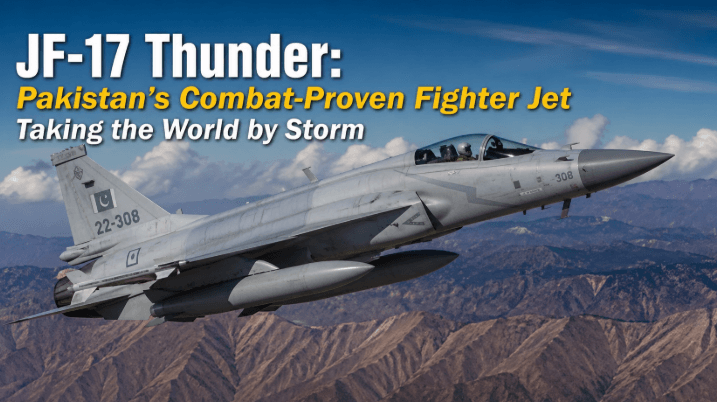
JF-17 Thunder: Pakistan’s Combat-Proven Fighter Jet Taking the World by Storm
Let’s start with JF-17 Thunder’s achievements and demands. After a meeting between Pakistan’s Air Chief Marshal and Bangladesh’s counterpart Air Chief Marshal Hasan Mehmood Khan, Pakistan’s Military’s media wing has announced that Bangladesh has shown interest in Pakistan’s domestically produced JF-17, and a deal has been done.
Many other countries, like Libya and Saudi Arabia, and 10 others have also shown serious interest in purchasing the JF-17 Thunder, but the Pakistani Military has yet to confirm a final deal in the media. Pakistan’s Defense Production Minister Raza Hayat has said that “these talks are taking place, but they can fall through due to international pressures, there are a lot of queries, but we are negotiating”.
Well, these were ongoing demands and deals, but what are the achievements of this fighter jet that everyone wants to buy from Pakistan, even in the presence of Russia’s F-35 and SU-57, respectively? It is because this fighter craft’s real combat success rate. In May 2025, when India struck on the Line of Control and Pakistan’s territory, Pakistan responded with multiple air operations and air defense. Pakistan used the JF-17 Thunder for the first time in real combat, alongside J-10C. It played an important role in maintaining air presence across multiple sectors as it was deployed in large numbers with J-I0C to form a mixed force. JF-17 was actually used for BVR combat. It relied on board radar to detect targets from long range.
Pakistan Air Defense claimed that JF-I7 launched precision weapons like CM-400AKG against the target (S-400 Triumf). The JF-17 Thunder was primarily used in Pakistan’s internal operations, such as Operation Zarb-e-Azb. It took part in a strike against militant hide-outs, using precision-guided bombs and conventional military weapons. Myanmar and Nigeria also used JF-17 Thunder against insurgent groups and militant groups as the crafts were exported to these countries.
Many other countries, like Libya and Saudi Arabia, and 10 others have also shown serious interest in purchasing the JF-17 Thunder, but the Pakistani Military has yet to confirm a final deal in the media. Pakistan’s Defense Production Minister Raza Hayat has said that “these talks are taking place, but they can fall through due to international pressures, there are a lot of queries, but we are negotiating”.
Well, these were ongoing demands and deals, but what are the achievements of this fighter jet that everyone wants to buy from Pakistan, even in the presence of Russia’s F-35 and SU-57, respectively? It is because this fighter craft’s real combat success rate. In May 2025, when India struck on the Line of Control and Pakistan’s territory, Pakistan responded with multiple air operations and air defense. Pakistan used the JF-17 Thunder for the first time in real combat, alongside J-10C. It played an important role in maintaining air presence across multiple sectors as it was deployed in large numbers with J-I0C to form a mixed force. JF-17 was actually used for BVR combat. It relied on board radar to detect targets from long range.
Pakistan Air Defense claimed that JF-I7 launched precision weapons like CM-400AKG against the target (S-400 Triumf). The JF-17 Thunder was primarily used in Pakistan’s internal operations, such as Operation Zarb-e-Azb. It took part in a strike against militant hide-outs, using precision-guided bombs and conventional military weapons. Myanmar and Nigeria also used JF-17 Thunder against insurgent groups and militant groups as the crafts were exported to these countries.
Why Countries Are Lining Up to Buy JF-17 Thunder: Key Reasons Behind Its Global Demand
But why do all these countries want the JF-17 Thunder? There are many reasons, including its affordability, maintenance, no-strings-attached nature, and weapons. Combat proved its training package. Let’s discuss in detail.
Affordability: A Cost-Effective Alternative to Western Fighter Jets
JF-17 is 3-4 times more economical than many jets, such as the Rafale or Eurofighter Typhoon. So one of the biggest reasons for JF-17’s demand is its being cost-effective. Despite its lower price, it features modern missiles and an Active Electronically Scanned Array (AESA) radar system. For many countries, it is a smart buy because it costs around $25M, whereas the F-16 costs around $60-70 million, and the MiG-29 costs $60-70 million.
Low Maintenance: Keeping Operational Costs Within Budget
JF-17 is attractive to countries because it requires less maintenance and its spare parts are much cheaper. Buying a jet and keeping it operational are both different things. This feature makes it optimal for countries with limited budgets.
No Political Restrictions: Freedom Over National Defense Decisions
Western jets come with political restrictions, such as limited use and the risk of sanctions. On the other hand, JF-17 provides freedom of use, with no political conditions. JF-17 offers more control over national defense decisions.
Weapon Compatibility: A Multi-Source Weapons System
The JF-17 Thunder has the capability to carry multiple weapons from different sources. This jet carries air-to-air missiles, including a long-range Beyond Visual Range (BVR) system, as well as air-to-ground strike weapons. This suppleness allows other countries to shape their combat capability.
Combat Proven: Tested in Real Battle Conditions
As discussed earlier, the JF-17 Thunder has been used in real combat against India in Operation Sindoor and again against an Indian jet that was shot down, whose pilot was Abhinandan Varthaman. Its operation involves advanced air defense systems like the S-400 missile system. So this jet is trusted because of its in-battle performance.
Training and Long-Term Support: More Than Just a Fighter Jet Sale
Pakistan does not sell fighter jets but also gives training to pilots, engineers, and maintenance personnel, as well as long-term operational support. These efforts from Pakistan are way more reliable and crucial for a country’s air force than imaginable.
Easy Modification: Built for Future Upgrades
JF-17 is easy to modify and understand because its software uses a simpler coding system like C++. So the jet is easy to upgrade when needed in the future.
The History of JF-17 Thunder: From Mockery to Global Recognition
The day JF-17 Thunder came to global discussion, everyone laughed and mocked the idea of it; it was not welcomed with applause. In the 1965 war between Pakistan and India, the Pakistani military was relying on America under the Central Treaty Organization (CENTO) and Southeast Asia Treaty Organization (SEATO) agreements, but after only two days of the war, America imposed a weapons embargo on both countries. This directly affected Pakistan and, in the worst way possible, because Pakistan’s military was dependent on America, while the Indian military had more Soviet weapons than American ones.
After the war had ended, it was time to make another trustworthy partner, and China was declared as that reliable partner, because China gave support to Pakistan during the Indo-Pak war. China had its own reasons for the support and friendship with Pakistan, like the Sino-Indian War that started in 1962 between China and India along the border. So, “the enemy of your enemy is your friend”.
China became the major weapon supplier for Pakistan. At that time, Pakistan had Western technology like aircraft, radar systems, and weapons. It was time for Pakistan to become self-reliant and self-sufficient.
In 1999, a conversation started about the production of their own aircraft, which would be designed by Pakistan Air Force technicians, pilots, and engineers.
Negotiations started with a company named CATIC. Everyone mocked this idea because of Pakistan’s sinking economy due to the wars. But where there is determination, nature itself creates paths toward success.
The production of this jet started in 1999. Both countries divided the $500 million cost. On this project, PAC and CAC both began the work. In September 2003, JF-I7’s first prototype flew on the runway; it had many issues because Chinese radars were used, whose range was very low, and it was also missing Western avionics. What is avionic? Avionics is like the brain to the jet; from these parts come the avionics, the pilot gets the enemy’s location, the other craft’s location, and the distance of the enemy from air to air or air to ground. On 23 March 2007, for the first time, JF-17 Thunder flew in Pakistan’s Defense Parade. It was coloured in Pakistan’s flag color.
It was named by the Joint Fighter, and number 17 was to show superiority over the F-16. The first block needed improvements, and improvements were made gradually. After the successful induction of Block I, Pakistan decided to manufacture it domestically at Kamra, a small town in the Attock district.
Block III of JF-17 Thunder was launched in 2020. It uses a Russian engine, and its ejection seat is from the famous Martin-Baker Company. Craft’s 58% production is taking place in Pakistan and 42% in China. This fighter jet lies under the same category as Eurofighter Typhoon, France’s Rafale, India’s Tejas, China’s J-10C, and Sweden’s Gripen.
JF-17 Thunder is no longer merely a fighter craft, but it is a global expression of confidence in Pakistan’s growing aerospace expertise.
[…] single F-35 fighter or JF-17 jet contains hundreds of pounds of rare-earth materials. Every missile, radar system, satellite, […]