
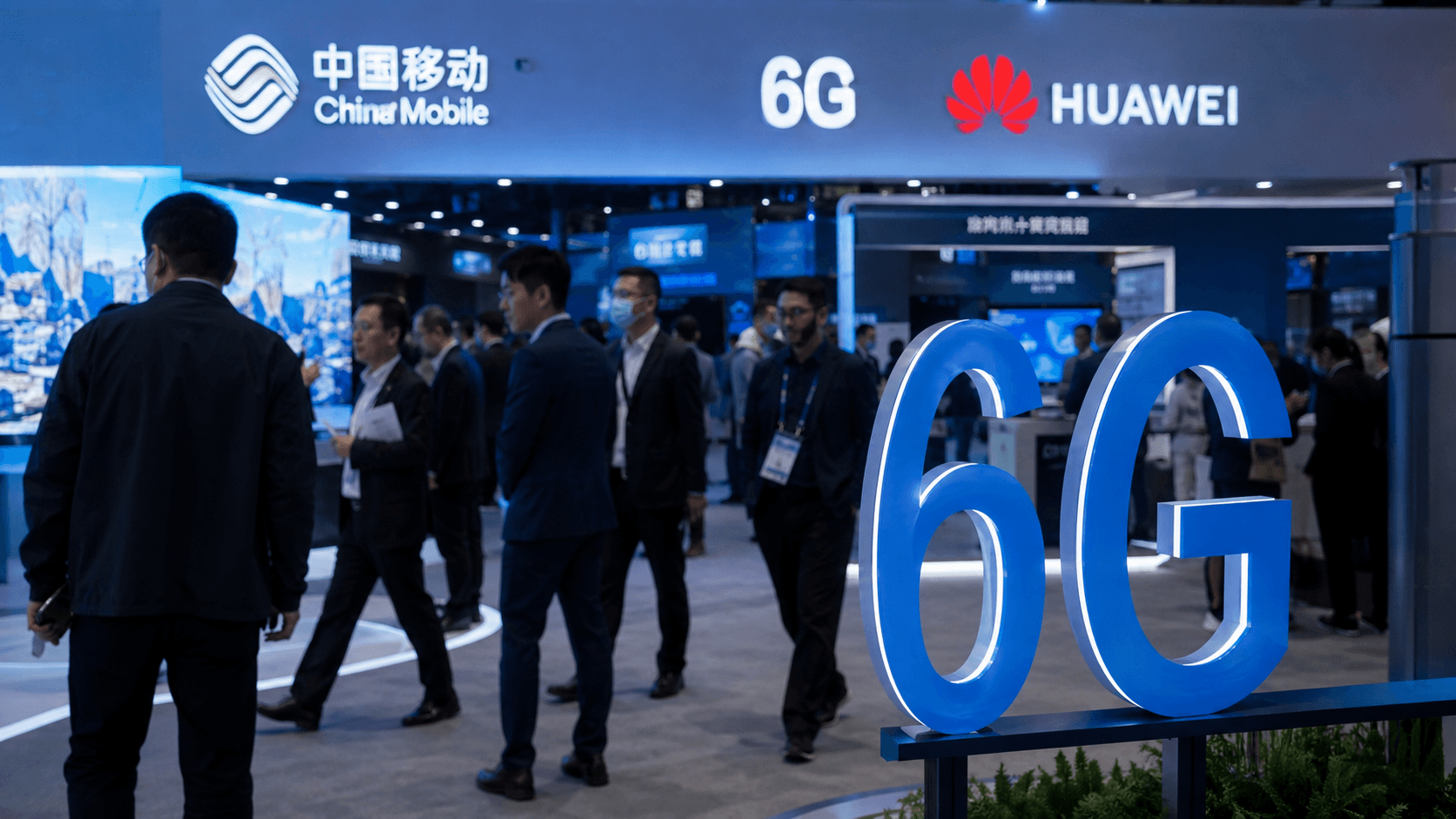
6G Technology: Who Controls the Next Digital Divide
In June 2026, members at a 3GPP plenary held in Singapore completed the development schedule for Release 21. This set of documents will describe the nature of 6G technology. The event was an important technical milestone, since it marked the first officially confirmed timeline for 6G standards. At the same time, the penetration of mobile broadband in Pakistan stood at 57-60 percent: approximately 148 million subscribers were still using 3G and 4G phones among 196 million users. The two timelines have different speeds of development. The first one is being developed in Singapore, Bonn, and San Diego.
The latter still needs some 4G towers to be installed in villages in Sindh and Balochistan.
What 6G Actually Changes
6G Technology should not be thought of merely as “the enhanced or faster 5G.” The essential difference lies in the complete change in architecture. Specifically, the networks must be developed based on the concept of AI-native networks, which implies that aspects such as spectrum allocation, traffic management, and the elimination of errors will all take place using machine learning.
Moreover, the national standards organizations will combine the communication and the sensing functions. In other words, 6G will not just allow for the transmission of data; it will also be able to recognize the environment. In particular, Release 21 is expected to use wider bands of spectrum than have ever been used for 5G networks, and the concept of AI-managed networks will be part of the initial design rather than an additional feature.
The main limitation is the spectrum. It has been pointed out that countries should have at least two or even three times higher amounts of mid-band spectrum in the future so that they can satisfy the demand for 6G in megacities by the 2030s. Some companies may need even 4 GHz of capacity in addition.
The Standards Race
The process of formalizing the standards of 6G has moved ahead in that dates have now been set. 3GPP has finalized a Stage-1 freeze dealing with necessities regarding service in March 2027; a Stage-2 freeze is scheduled for June 2028, and full specifications will be completed in early 2029, with 80% of the work expected to be done by March 2028. However, the meeting in June 2026 has not only formed the timeline but has also shown how uncertain the basics remain, with the question of whether the 6G system will have new radio specs or will still be utilizing the infrastructure of 5G unresolved. Neither are the issues of how operators will adopt the new system and how current compatibility will be available.
The US is counting on its telecommunications operators and semiconductor companies to continue cooperating. In March 2026, Qualcomm and T-Mobile expanded their collaboration with the goal of hastening the transition from 5G Advanced to 6G, seeking to implement commercial operations by 2029. At the same time, T-Mobile launched its 6G Innovation Center with Deutsche Telekom, combining its laboratory in Bellevue with T-Labs in Berlin. Determined to keep up with state-led developments, T-Mobile’s initiative illustrates the need for telecommunications companies in the West to share their research capabilities.
China is not waiting for consensus at 3GPP to get started. The stated plan of the Chinese authorities is to finish the research necessary for the new technology by 2025, start drafting the standards in 2026, and achieve commercial functioning by 2030. China’s move is coordinated by China Mobile, China Telecom, and China Unicom.
Instability regarding American infrastructure extends beyond the announcement of any 6G technology. In May 2026, AT&T, T-Mobile, and Verizon agreed to combine their frequencies and satellites, as the companies plan together a solution to the problem of poor coverage in the US. The decision came after the launch of a competing service from Starlink providing direct-to-device satellite connections. The collaboration between companies demonstrates the fact that this type of service still has significant problems, even in the US, which is an initiator of the new 6G technology.
The battle for standardization is being fought against the backdrop of the battle for semiconductor supremacy, where South Asia has an important role to play. Producing 6G’s various components, including AI-based baseband processing and edge computing, requires sophisticated chip manufacturing technology that only a handful of companies control.
China is focusing on advanced logic production and decreasing its reliance on foreign lithography equipment in its latest five-year plan, striving for self-sufficiency instead of keeping up with what the world has to offer in terms of technology. In the United States, easing export controls has led to higher uncertainty over the 2026 policy direction, even though congressional hawks are unhappy about it. Pakistan is directly affected by this situation because it is not involved in these processes at all and does not possess the means to produce chips domestically.
The South Asia Gap
This is the area that typical tech reporting tends to overlook. The numbers matter more. By the end of 2025, Pakistan had achieved internet penetration of 45.6% of the population, or 117 million users out of 256 million people.
For many years, Pakistan faced a shortage of available spectrum — only 274 MHz was allocated over almost ten years, one of the lowest figures in the region. This situation changed in March 2026, when Pakistan held the largest spectrum auction in its history, resulting in an almost threefold increase in spectrum availability to more than 750 MHz. The total investment made by operators like Jazz, Zong, and Ufone amounted to $510 million, which was paid in exchange for 480 MHz of spectrum in the frequency range from 700 MHz to 3500 MHz.
Nonetheless, having a larger quantity of spectrum does not mean that it can be easily used: in early 2026, only 15-18% of mobile towers had fiber connections in Pakistan, unlike 80-90% of the same towers in developed countries. Without fiber backhaul, additional spectrum will not necessarily generate any practical benefits. 4G speed remains below this figure and stays around 17-20 Mbps. More than 40% of subscribers still use feature phones and cannot take advantage of modern mobile broadband technology.
The situation is complicated by the geographical layout of the new system.
Operators plan to make their next-gen services available in Karachi, Lahore, and Islamabad first, while almost 70% of the population of Pakistan – the rural majority – has difficulties with 4G. Deploying high-band requires a large number of towers, while achieving actual coverage in areas that have been left behind means using mid- and low-band frequencies, costing billions. However, such financing is not planned to be provided.
Pakistan is not really an exception in the region — rather, it is a more concentrated representation of the regional trend.
India has advanced in terms of 5G infrastructure in metropolitan areas; Bangladesh has more spectrum despite the smaller size of its economy, although the economic gap is still visible throughout South Asia: telecommunication investments are overly concentrated in certain metropolitan areas, while rural areas, which comprise the majority of the population, are seen by the telecom providers as an afterthought instead of a priority.
In other words, the previous generations of mobile networks have codified the unwritten principle according to which it is feasible to lead investments into a handful of lucrative metropolitan markets at the expense of all other non-market areas that are not well covered.
The key issue is that the economies of standard-setting and infrastructure deployment are vastly different, and Pakistan (like much of South Asia) is only participating in the latter. Being a rule-taker means paying licensing fees for IP that has been created in other countries, paying for hardware that has been produced according to specifications decided upon without any representation from the country, and paying the global price for spectrum or equipment in accordance with whatever standards are settled around, irrespective of what it can afford to pay for it.
With less than one-fifth of its towers connected to fiber and remote rural areas still having poor 4G connectivity, the country will not be able to become a 6G standard maker and will instead remain a consumer by 2029.
What This Actually Determines
However, this debate is not about quicker downloads at all. The topic under consideration pertains to the individuals who will take advantage of the next stage of the internet, the next connectivity level, which involves the use of the artificial-intelligence-based system of internet management, the sensor infrastructure, and the edge computing technologies. Those countries that participate in the development of standards also have opportunities to choose standards since it allows them to make money from the use of their patents and to be the first in the sector of different internet services.
For countries such as Pakistan and some others, it is more important for them to deal with issues such as spectrum policy, rural fiber investments, and ensuring the stable quality of internet service instead of thinking about 6G. The authorities have already warned that if there is no clear stimulus system, the inhabitants of rural regions may stay cut off from new-generation internet services forever, not just temporarily.
The Line Being Drawn
3GPP will freeze Release 21 by December 2028. By 2029, the initial commercial 6G networks are likely to be up and running in the US, China, and part of the EU. Currently, Pakistan is on its way to providing reliable 4G to 70 percent of the rural population of the country. In a decade, the infrastructure gap will no longer be measured in megahertz or megabits but rather in terms of network ownership or simply its usage.