
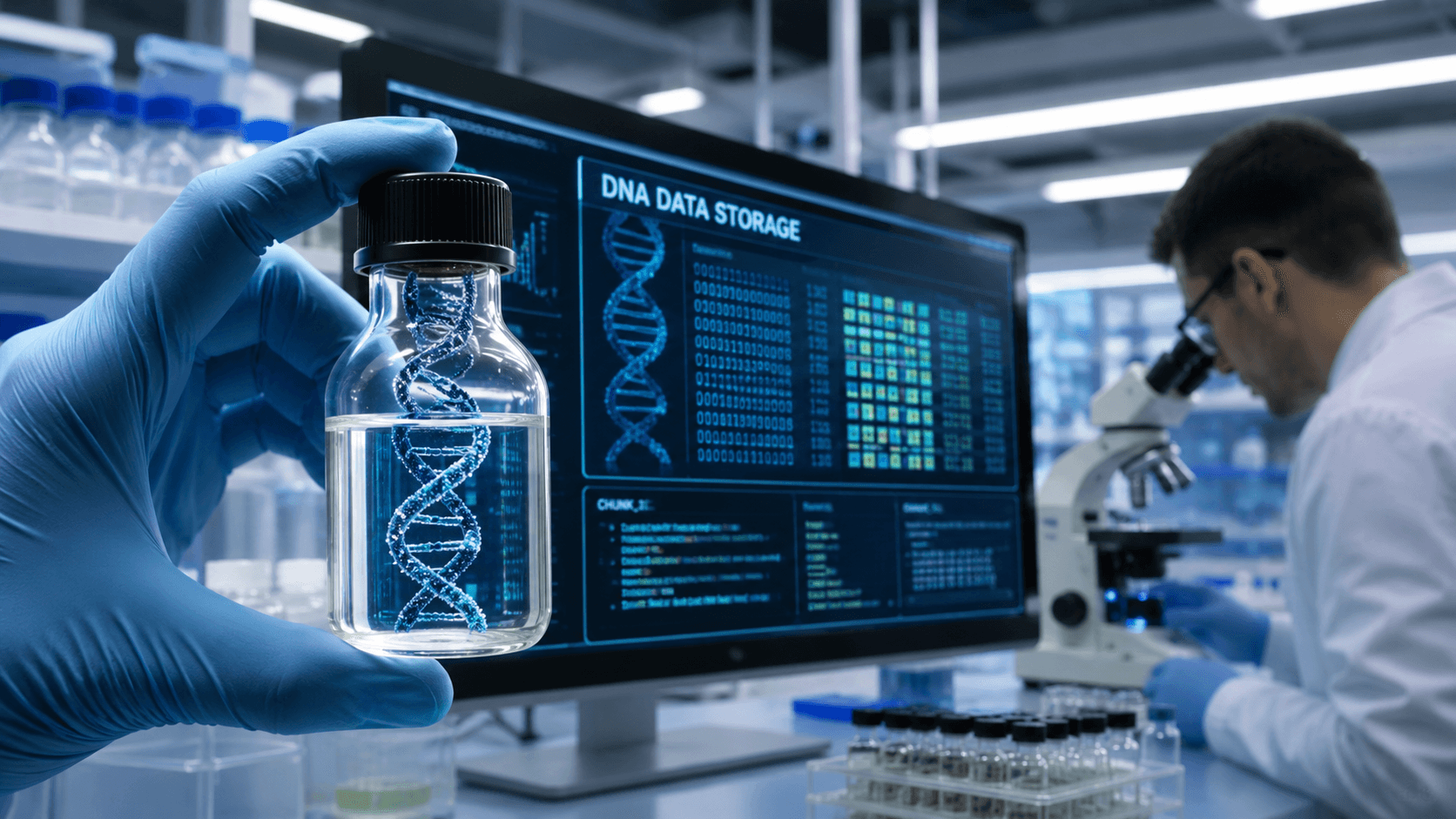
How DNA Data Storage Works: Synthetic Biology’s Plan to Store the Internet in a Flask of Liquid
What Is DNA Data Storage, Exactly?
DNA data storage is the process of converting digital binary code — the 0s and 1s that make up every photo, video, email, and line of code — into sequences of DNA’s four nucleotide bases: adenine (A), thymine (T), cytosine (C), and guanine (G). Instead of storing information as magnetic charges on a spinning disk, the data is stored as a chemical sequence, synthesized in a lab and preserved in a small vial.
It sounds like science fiction, but it is already commercial reality. Twist Bioscience’s storage division, spun off in 2025 as Atlas Data Storage, has publicly targeted terabyte-scale demonstrations — encoding roughly 13 terabytes of data into a volume smaller than a droplet of water. Researchers at Tianjin University have gone a step further, engineering a synthetic yeast chromosome that carries 254 kilobases of DNA and successfully used it to store two full images and a video file inside a living cell.
How DNA Data Storage Works, Step by Step
The process of encoding a file into DNA follows a logical, almost elegant pipeline:
1. Digital-to-DNA Encoding
A computer algorithm converts a file’s binary code into a base-4 code instead of base-2. Where a hard drive only has two symbols (0 and 1) to represent data, DNA offers four (A, T, C, G), which is part of why its theoretical data density is so much higher than anything silicon can achieve.
2. DNA Synthesis (“Writing”)
Specialized DNA synthesizers — often built on silicon chip arrays, similar to the platform being developed under Fraunhofer’s BIOSYNTH project — chemically assemble short DNA strands that match the encoded sequence. Each strand is typically tagged with an “index” sequence, essentially a molecular barcode that records where that fragment belongs in the larger file, so it can be located later without decoding the entire archive.
3. Storage
Once synthesized, the DNA is dried, encapsulated, or simply kept in a stable liquid buffer. It requires no electricity, no climate-controlled server room, and no refresh cycles. It just sits there, chemically inert, for centuries.
4. Sequencing (“Reading”)
To retrieve the data, the DNA is run through a sequencer, which reads the order of bases and reconstructs the original binary file using the same encoding key applied in reverse. Error-correction methods — including sparsified low-density parity check (LDPC) codes borrowed from telecommunications engineering — are layered in to catch and fix the small mutations or misreads that can occur during synthesis or sequencing.
Molecular Data Storage Advantages Over Traditional Data Centers
The appeal of DNA as a storage medium comes down to three numbers that traditional enterprise data archiving simply cannot compete with:
- Density. Researchers at Penn State describe DNA as nature’s most efficient storage mechanism, capable of holding around 215 million gigabytes of data in a single gram. Some industry estimates push this even higher, toward the petabyte-per-gram range, meaning a shoebox of synthesized DNA could theoretically hold more data than every hyperscale cloud storage facility on the planet combined.
- Longevity. Magnetic tape degrades within 10 to 30 years. Hard drives fail even sooner. DNA, by contrast, has been recovered and successfully sequenced from wooly mammoth remains tens of thousands of years old. Industry researchers have cited a stable shelf life measured in centuries to millennia when properly stored, especially if kept cold and dry — no re-encoding, no bit rot, no format obsolescence.
- Energy efficiency. A hyperscale data center consumes megawatts of continuous power for cooling and redundancy. A vial of DNA in a freezer consumes none essentially. As AI workloads push global data center energy consumption to record highs, “cold” molecular archives offer a genuinely carbon-light alternative for data that doesn’t need to be accessed in real time.
Synthetic Biology Data Archives: Where the Real Innovation Is Happening
What separates today’s DNA storage research from the lab curiosities of a decade ago is the fusion of synthetic biology with information engineering. It’s a pretty big leap to move beyond asking if DNA is capable of storing data to investigating whether biological and hybrid systems can perform data storage, maintenance, and management independently.
The Tianjin University project is a good example: rather than storing DNA passively in a test tube, the team engineered a functioning artificial chromosome inside a living yeast cell — essentially giving the data a biological “home” with its own replication and repair machinery. Meanwhile, researchers at Arizona State University have pushed past sequence-based storage entirely, exploring DNA origami — folding synthetic DNA into precise three-dimensional nanostructures that encode information not just in their genetic letters, but in their physical shape, adding a built-in layer of encryption that is nearly impossible to read without the correct molecular “key.”
Perhaps most strikingly, engineers at Penn State have begun merging synthetic DNA directly with semiconducting perovskite materials to build ultra-low-power memory devices — a hybrid of biology and electronics that could eventually let DNA-based memory sit inside a chip rather than a vial, narrowing the gap between molecular archives and everyday computing hardware.
The Catch: Why Your Cloud Storage Isn’t Switching to DNA Yet
For all its promise, DNA data storage remains firmly in the “future tech” category for a few concrete reasons:
- Cost. Commercial DNA synthesis has historically run from a fraction of a cent to several cents per base, and encoding even a single megabyte requires millions of bases. Industry analysts project DNA storage won’t become cost-competitive with magnetic tape for cold archival use until roughly 2028–2030.
- Speed. Writing and reading DNA is measured in hours, not the microseconds of an SSD. This makes it unsuitable for anything requiring real-time access — it’s built for archives, not active workloads.
- Scale of synthesis. Producing DNA at the volume needed to store zettabytes of global data requires manufacturing infrastructure that doesn’t yet exist at commercial scale, though companies like Atlas Data Storage are explicitly racing to build it.
[…] big leap to move beyond asking if DNA is capable of storing data to investigating whether biological and hybrid systems can perform data […]