
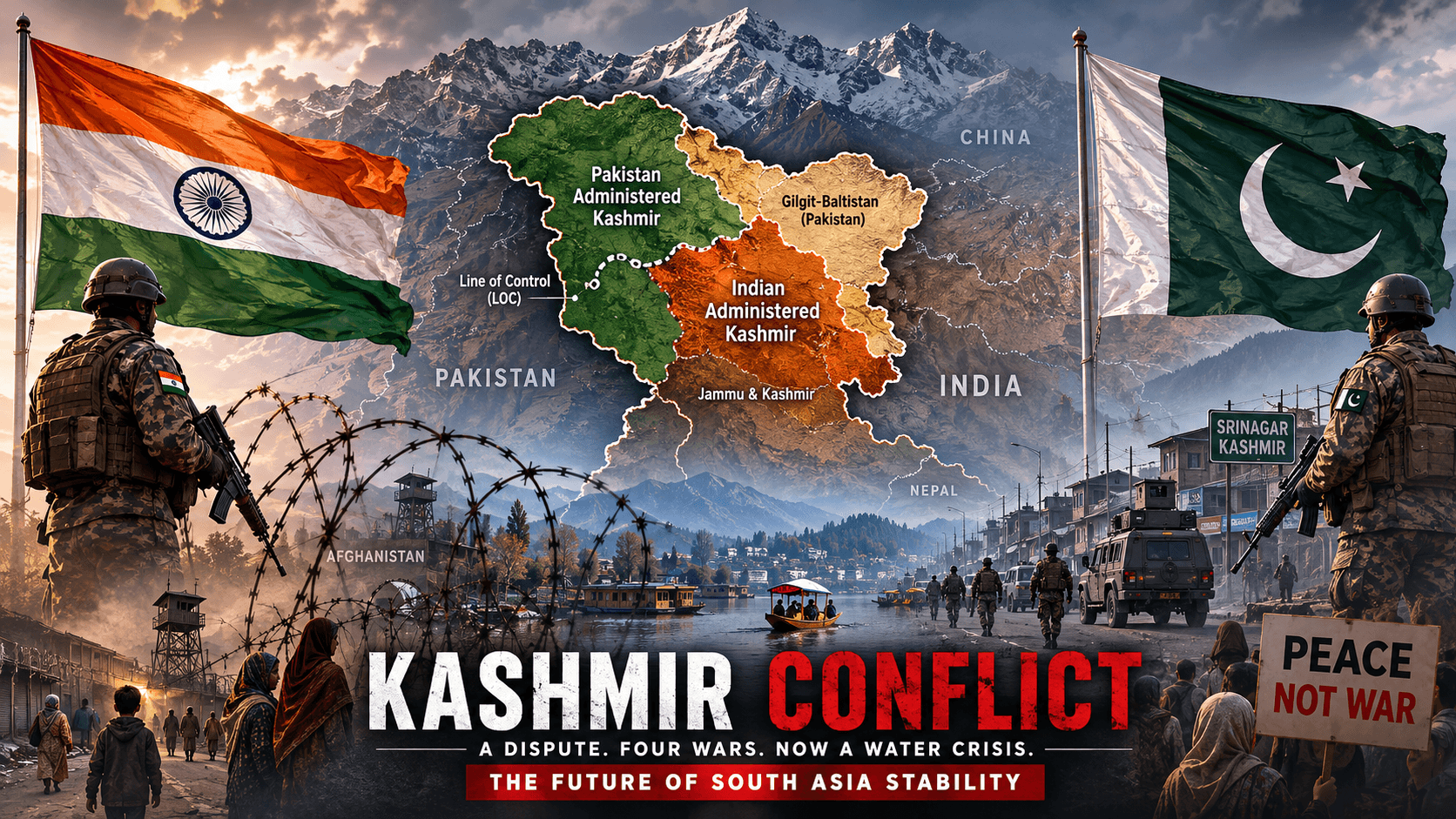
Kashmir Conflict: History, Wars, Water Crisis, and What Comes Next
On the heights of the Himalayas lies a land of spellbinding beauty, but one of the world’s most conflicted flashpoints. For years and decades, Kashmir has remained the focal point of a contentious territorial dispute that fundamentally altered the history of South Asia, kindled multiple hostilities, sparked decades of violence, and brought two nuclear-armed neighbours constantly pushing toward the verge of warfare.
Geography, politics, identity, and national ambitions collide behind the frosted peaks and virgin valleys of Kashmir. Beyond a territorial dispute, the 21st century’s conflict over Kashmir is not only a struggle over land but is also becoming a bigger challenge to global security and regional stability.
Why Is Kashmir Disputed
The conflict in Kashmir is one of the world’s oldest and most prolonged conflicts. The Kashmir dispute was rooted in the partition of British India in 1947.
At the time of partition, Jammu and Kashmir was an independent state, and the majority of the population was Muslim, but the leader was a Hindu, Maharaja Hari Singh. Initially, the state tried to remain independent, but in October 1947, after the armed tribal incursion from Pakistan, Maharaja Hari Singh signed the Instrument of Accession to India.
After this, India sent its military to Kashmir. Pakistan didn’t accept this accession because it was against the will of the people living in that region. The disagreement led to the first Indo-Pak war in 1947-48.
Indian troops entered Srinagar and pushed the Pakistani raiders back, but not all the way, and a stalemate was entrenched along the Line of Control (LOC), a de facto border that is still divided into Pakistan- administered Azad Kashmir and Gilgit-Baltistan and Indian-administered Jammu and Kashmir.
UN Intervention
After the Indo-Pak war of 1947-48, the United Nations intervened in the Kashmir dispute when India took this case to the UN, referring to it as a security threat to international peace, arguing that the armed Pakistani fighters entered Jammu and Kashmir. On April 21’ 1948, the UN adopted its Resolution 47, which urged a ceasefire and the reduction of Indian military forces under specified conditions.
The third step of the UN was to conduct a direct vote in Kashmir, so they could determine their future. The plebiscite was never held; India disagreed over the complete withdrawal of forces, while Pakistan argued that the pledges under the resolution were not fulfilled.
Four Wars
India and Pakistan have fought four major wars/conflicts since 1947, three of which were directly connected to Kashmir.
- The first Indo-Pak war began in 1947-48, after the partition of British India. Explained above.
- The second Pakistan-India War was fought in 1965. Pakistan launched Operation Gibraltar, which ended up sparking a full-scale war when India responded militarily.
- The third war in 1971 started primarily because of the Bangladesh Liberation War, when refugees fled to India, but it affected the conflict in Kashmir by extending the western front. After the war, both neighbours signed the Simla Agreement in 1972, which established the ceasefire line in Kashmir.
- The Kargil War was fought in 1999, when the LOC in Kargil was occupied, resulting in limited but intense conflict.
The most important and substantial turning point came in August 2019, when India revoked its Article 370. According to the article, Jammu and Kashmir was a semi-autonomous state, had its own flag, and outsiders were restricted from buying land there.
Pakistan called this an illegal move under international law and reduced its diplomatic relations with India; meanwhile, New Delhi named it an economic opportunity and integration.
But for Kashmiris, it was the point where political voices were almost nullified. During all this time, communications were cut off, their political leaders were arrested when they tried to raise their voices, and heavy security was deployed.
2025-26: The Crisis That Redrew the Map of Risk
The situation became more serious after years, when 26 civilians were killed by militants on 22nd April 2025. Most of them were tourists in Pahalgam, Indian-administered Kashmir. India charged Pakistan’s militants. Pakistan denied it, calling for an independent investigation.
India launched missile strikes against Pakistan and Pakistan-administered Kashmir on the nights of 6-7 May 2025. The operation was named Operation Sindoor by India. Dozens of people were killed in firing on the Line of Control, several days before the ceasefire was held. In retaliation, India suspended its participation in the Indus Water Treaty, an agreement that was signed in 1960. The move prompted Pakistani officials to warn that any threat to the water security of the country could provide grounds for war.
It’s Not Just About Land Now
It’s Not Just About Land Now: A year after the Pahalgam attack, the tension between the two countries is rising again, but this time it’s not territorial, but about access to the water from the Indus River basin.
The Indus Water Treaty regulates the utilization of rivers of the Indus basin; the Indus basin is shared between four countries: Pakistan, India, China, and Afghanistan. Pakistan has the right to use western rivers, and India has access to use eastern rivers without restriction.
Water Suspension by Indian Officials
India’s foreign minister said publicly on June 5 that the water treaty would stay suspended until Pakistan completely stops border terrorism. India’s water resource minister C.R. Patil said that ‘New Delhi will ensure that Pakistan will not get a single drop of water in the upcoming years’.
The stakes are high for Pakistan, because according to the report of Washington-based think tanks, nine out of ten Pakistanis’ lives depend upon the Indus basin, which irrigates more than 90% of the country’s crops and hydroelectric power. All of Pakistan’s hydroelectric power plants are located within the Indus basin.
The risk of glacial lake outburst floods across Gilgit- Baltistan as Himalayas glacier is becoming more unstable, according to Pakistan’s meteorological department.
The two countries could be responsible for the flood warnings and water management in the Indus basin, which are currently not speaking to each other but are threatening. The analysts are describing water as the most dangerous and long-term flashpoint, more than territory between both countries.
What Comes Next
The situation between Pakistan and India is a ceasefire, but without any resolution. UAE, USA, and China have played their roles in mediating the truce. But till now neither of the two countries has come to the negotiation table. Militaries from both countries are on high alert. Violations have been seen on the LOC.
Death of Protesters
Death of Protesters: Dozens of people have been killed in clashes between protesters and security officials in Pakistan-administered Kashmir over the last two months.
According to the BBC’s reports, the crackdown in Rawalakot has sealed it off from the world. People were protesting against the shutdown of healthcare, the internet, and electricity shutdown and the current regional elections.
A dispute over 12 reserved assembly seats ignited the latest unrest, but the protests in Rawalakot and Muzaffarabad are the product of three years of accumulated grievance, where residents are being treated as subjects rather than citizens.
People Of Kashmir
Civilians of Kashmir rarely fight any war; they don’t become part of the armed forces. But the consequences of war have always been borne by Kashmiri civilians.
Every new tension brings curfew, economic disruptions, and communication shutdowns to the civilians whose economy depends mainly on tourism.
Political representation of Jammu and Kashmir has always been a sensitive issue. After years of direct federal rule, it is commonly viewed as holding very little power against nationally appointed administrators.
In the other part of Kashmir that is administered by Pakistan, people are being killed by their own army for protesting against the inflated electricity bills, wheat subsidy cuts, and a sense of being treated as a borderland by the Capital.
Ending Note
The conflict of Kashmir was never only because of the accession signed by a Hindu leader. It survived generations of conventional war, was stripped of control, and now became a contest over rivers and glaciers that actually matters to the millions and billions of lives on both sides.
The question arises, that who will control the LOC, the water, and the territory in the future?