
Why Taiwan is Important for the World.
Taiwan is very small. In fact, it is so small that you must zoom in on your map to locate it. Taiwan is even smaller than some of the larger states of India by size (area), yet despite these measurements, Taiwan has a very large economy (Nominal GDP $884.39 billion and 3.7% GDP Growth Rate as of 2025) and importance. Some experts say, “If Taiwan falls, the global economy would face serious disruption.”
Taiwan is a small island that is attracting the world’s attention because it has a unique combination of history, economy, and strategic importance.
The Tiny Island at the Center of Global Politics
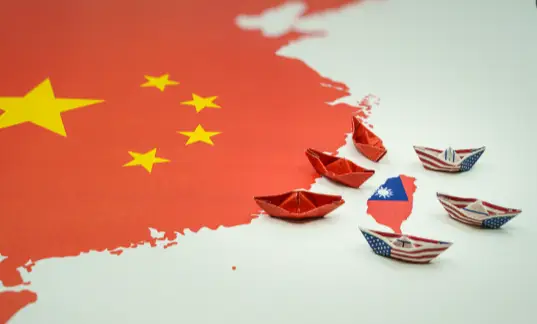
Taiwan may be a small island, but over the years, it has been the subject of numerous international disputes over its status as an independent nation. The majority of countries, including both the United States and even India, do not recognize Taiwan as a separate nation. However, both the U.S. and China are heavily invested in their future.
China claims Taiwan as its own territory and has vowed to take control of the island. The U.S. maintains an official policy of not recognizing Taiwan as an independent nation. However, the U.S. has a military presence and significant trade interests in the island. The uniqueness of its situation has resulted in the island being viewed as a “time bomb” for geopolitical issues; Any potential military conflict involving Taiwan could send shockwaves across the world.
A History of Loss and Survival
The One-China Policy
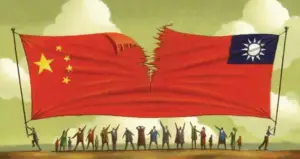
In 1971, Taiwan’s geopolitical troubles intensified after it was expelled from the United Nations. The UN removed all of its seats, flags, and diplomats, and officially recognized the People’s Republic of China as “One China.” By the mid-1970s, after two decades of support for Taiwan’s independence and the establishment of diplomatic relations with Taiwan, the United States began aligning its policy toward China with China’s demand for a “One China” policy. The goal of this change was to enable the United States to gain access to China’s markets and to drive a wedge between the People’s Republic of China and the Soviet Union during the Cold War. Today, even though Taiwan is not officially recognized as a sovereign nation, it has retained significant economic and strategic power despite having no official recognition.
The Oil Crisis and Economic Pivot
Taiwan experienced the 1970s worldwide oil crisis with a sharp increase in oil prices that hurt its toy, plastics, and light-producing industries. Therefore, it knew that it must establish a profitable industry that would provide it with a competitive advantage and allow for growth in this global economy.
The Semiconductor Revolution
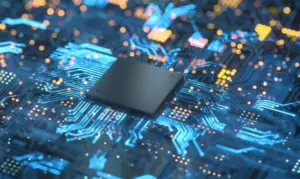
The Semiconductor Industry is Taiwan’s answer to the Global Economic Collapse. The Semiconductor Industry was established by the Taiwanese Government in 1974, after an important meeting between a Taiwanese Minister and a Taiwanese scientist
- TSMC (Taiwan Semiconductor Manufacturing Company), founded by Morris Chang, produces over 80% or four-fifths of the advanced chips used today.
- The Global Dependency:
TSMC manufactures most of the essential chip components used to manufacture all mobile phones, computers, missiles, and other consumer goods in the world. Without these components, all sectors of the economy, particularly automotive and electronics, come to a complete standstill. A prime example of this was the 2020-2023 semiconductor shortage, which led to millions of vehicles remaining on factory floors, ready for sale, because they could not be manufactured without the chip components.
The 2020–2023 Chip Shortage
The global chip shortage occurred due to multiple factors:
- The United States imposed sanctions against China’s Semiconductor Manufacturing International Corporation (SMIC), which caused an interruption in China’s ability to produce chips. Global demand shifted from China to Taiwan Semiconductor Manufacturing Company (TSMC).
- Natural catastrophes have caused Taiwan to experience droughts, with the result being a slowdown in chip production since the manufacturing of chips requires a large quantity of water.
- The conflict between Russia and Ukraine has also resulted in a disruption of the supply of neon gas necessary for chip production.
An earthquake that hit Japan has impacted the supply chain of many other materials, which are needed for chip production. This shortage highlighted Taiwan’s critical role in the global economy and technology sectors.
The Silent US-China Conflict
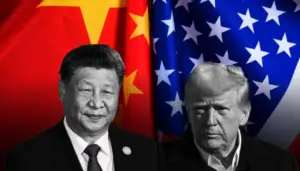
Taiwan is at the center of an ongoing struggle between the United States and China for control over its military power, high-tech products (including chips for smartphones, defense systems, etc.), and the most advanced semiconductor supply chain. Essentially, China applies constant pressure, seeking to assert control over the island and warning of military action if the US intervenes. Another principle that adds more complexity to the situation is known as ‘strategic ambiguity’.
The United States is legally bound to defend Taiwan by virtue of the Taiwan Relations Act. However, the United States does not have to officially recognize Taiwan as a sovereign state. Thus, through this form of ambiguous strategy, the United States keeps China in uncertainty regarding its ultimate intention when it comes to its security and future.
Concerning global technological advancement, whoever controls Taiwan will be the country that controls the global technology future and, subsequently, the global economy.
Why Taiwan Will Always Be Critical
It is a relatively small island nation, but it has an outsized strategic, economic, and technological profile. It has the world’s largest semiconductor industry, dominated by TSMC, which provides chips that are critical to most modern technology products. The island has emerged as the epicenter of geopolitical confrontation between global powers and has become a focal point of tensions over that confrontation. Taiwan exemplifies how a nation can exert geopolitical influence based on its strategy, innovation, and technological expertise rather than size alone.
[…] the ability to conduct a World War III. The strait connects East China to West China and separates Taiwan from […]