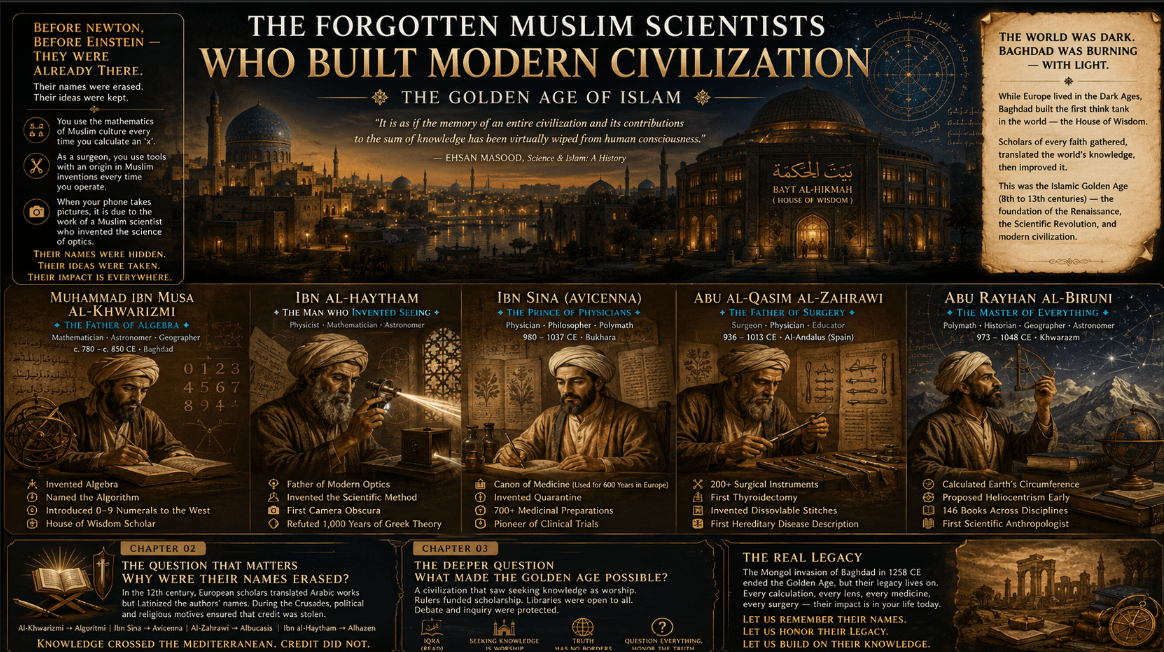
The Forgotten Muslim Scientists Who Built Modern Civilization – The Golden Age of Islam
Before Newton, before Einstein — they were already there. Their names were erased. Their ideas were kept.
“It is as if the memory of an entire civilization and its contributions to the sum of knowledge has been virtually wiped from human consciousness.”
Ehsan Masood, Science & Islam: A History Science & Islam: A History
You use the mathematics of Muslim culture every time you calculate an ‘x‘. As a surgeon, you utilize tools with an origin in Muslim inventions whenever you operate. When your phone takes pictures, it is due to the work of a man who pretended he was insane to escape death and spend his life writing the laws of optics while under house arrest — a Muslim!
The statements made above are all historically documented and considered as peer-reviewed evidence. All the names associated with historical contributions have been hidden, Latinized, or attributed to Europeans who discovered them long after they had already existed.
This is not a feel-good story to keep you warm at night — this is the revelation of the historical record, which shows how those who lived in the world’s most influential empire viewed ‘curiosity’ as an act of religious expression and created an extraordinary empire of knowledge that has supported or influenced our current way of living.
◆ The Golden Age ◆
Chapter 01
The World Was Dark. Baghdad Was Burning — With Light.
The date is 830 CE. Europe has been called “the Dark Ages” by historians for good reason: little scientific advancement, many diseases, and knowledge that has been protected in monasteries.
This very different story was being told in Baghdad. This was the time of Harun al-Rashid, and his son, Al-Ma’mun, and they built something that had never before existed—the Bayt al-Hikmah.
This new institution was not just a library; it was the first think tank in the world. This was a government-supported research centre, where scientists from different religious backgrounds (Muslim, Christian, Jewish, Zoroastrian) would meet, eat, and most importantly, think together!
This new centre was established to send scientists out into the world to collect all kinds of knowledge: Greek manuscripts; Indian mathematics; Persian astronomy … everything they could find; translate it; read and understand it; then improve upon it as best they could. The Islamic world did not use to preserve ancient knowledge—they challenged it, questioned it, and rebuilt it.
This period is best known to historians as the Islamic Golden Age (8th to 13th centuries). The work of these scientists served as the foundation for the Renaissance, the Scientific Revolution, and ultimately built modern civilization.
Here are five of the most important. And why you’ve probably never heard their real names.
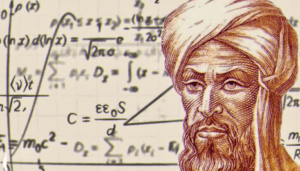
Muhammad ibn Musa al-Khwarizmi
◆ The Father of Algebra ◆ Mathematician · Astronomer · Geographer
c. 780 – c. 850 CE · Baghdad, Abbasid Caliphate
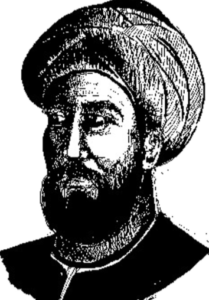
Muhammad ibn Musa al-Khwarizmi
When you say the word ‘algorithm‘, you’re also saying the mathematician Al-Khwarizmi’s name out loud; this was the Latinized way of saying his name when European countries translated his works in the 12th century.
Additionally, the word ‘algebra‘ comes directly from the title of Al-Khwarizmi’s most popular publication — that is, Al-Kitab al-Mukhtasar fi Hisab al-Jabr wal-Muqabala, or ‘The Compendious Book on Calculating by Completing and Balancing’, which introduced algebra to the Western World.
Al-Khwarizmi is also credited with introducing the Hindu-Arabic numbering system (the one you know as 1, 2, and 3) to the Western world, replacing the cumbersome Roman number system that made complex calculations extremely difficult, if not impossible. Because of him, there is no calculus, no computer science, or modern forms of mathematics as we know them today.
Invented Algebra
Named the Algorithm Introduced 0–9 Numerals to the West House of Wisdom Scholar
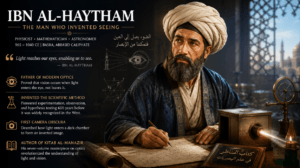
Ibn al-Haytham
◆ The Man Who Invented Seeing ◆
Physicist · Mathematician · Astronomer
Ibn al-Haytham
Every selfie you take, every movie that you watch, each telescope, microscope, camera, and lens that you own, and even all the glasses & lenses ever made throughout the history of mankind can all be traced back to one man who lived in a house in Cairo for ten years, feigning insanity to avoid execution.
The tale of this man’s life is so filled with tragedy and drama that it would seem unbelievable if someone were to tell it to you.
Ibn al-Haytham hastily promised the Caliph of Egypt (Al-Hakim) that he could stop the flooding of the Nile River when he arrived and found out that it would be impossible to engineer this remedy. With no way to escape the inevitable wrath of the Caliph, he faked his insanity so that he would not be executed.
Under Islamic law, a person who is insane cannot be sentenced to death. Thus, he spent ten years displaying erratic behavior as a result of his insanity while secretly in his room rewriting the entire story of what light is, how it behaves, and how we perceive light.
His seven-volume masterpiece, known as Kitab Al-Manazir (Or the Book of Optics), destroyed over 1,000 years of Greek thought concerning vision and light. The ancient Greeks (including Euclid and Ptolemy) were of the belief that rays of light were emitted from the eye and came into contact with objects that we were attempting to see. Ibn al-Haytham proved this theory to be exactly the opposite of reality.
Light reaches our eyes, enabling us to see. He was at the forefront of the Modern Scientific Method, the way that resulted in creating experimental scientific practices — forming hypotheses, designing experiments, measuring results, and then revising our conclusions — about 600 years before Francis Bacon is credited with it. In 2015, he was recognized by UNESCO for his work in optics and also for laying the groundwork for experimental science itself.
Father of Modern Optics Invented the Scientific Method First Camera Obscura Refuted 1,000 Years of Greek Theory
Ibn al-Haytham was the first person to methodically build instruments for testing hypotheses and confirming the validity of his results. By using concrete, physical experiments, he helped establish the modern scientific method.”
— Muslim Heritage Foundation
Ibn Sina (Avicenna)
◆ The Prince of Physicians ◆
Physician · Philosopher · Polymath
980 – 1037 CE · Bukhara (modern Uzbekistan)
Avicenna (Ibn e Sina)
He memorized the Quran at age ten. By sixteen, he had mastered philosophy, law, and mathematics. At twenty-one, he authored a work that became the main medical textbook in European universities for over six centuries.
The Canon of Medicine – Al-Qanun fi al-Tibb – is one of the largest contributions to the history of medicine. It included 700 different types of medications, first introduced the concept of quarantine as a method to protect against the spread of diseases, identified tuberculosis as a disease that could be spread through contact with an infected person, created the idea of a clinical trial, and has been used for testing the biological effects that certain medications had on animals before testing them on humans.
Also, Ibn Sina outlined the use of oral anesthesia during surgery, and his work demonstrated the hereditary nature of some diseases, while establishing that emotions and states of mind could affect a person’s physical health, thereby establishing a basis for psychosomatic medicine.
During the 12th through 17th centuries in Europe, Ibn Sina (known as “Avicenna” in the West) was a major figure in European medicine, comparable to Hippocrates. His Canon of Medicine was printed and distributed throughout Italy, France, and England. Its name changed from Al-Qanun fi al-Tibb to The Canon of Medicine, but it was largely forgotten as to who authored the text.
Canon of Medicine (Used for 600 Years in Europe)
Invented Quarantine 700+ Medicinal Preparations Pioneer of Clinical Trials
Abu al-Qasim al-Zahrawi
◆ The Father of Surgery ◆
Surgeon · Physician · Educator
936 – 1013 CE · Al-Andalus (Muslim Spain)
Abu al-Qasim al-Zahrawi
Today’s surgical instruments were created in the 10th century by a Spanish man who was known in the West as Albucasis. Al-Zahrawi created over 200 surgical instruments, many of which inventively employ nonmodern technology (or improve upon modern technology) as well. His 30-volume complete medical encyclopedia, Kitab al-Tasrif, devoted an entire book to surgery and contained the first illustrated guide on how to use surgical instruments. He also invented over 200 surgical instruments.
Al-Zahrawi was a pioneer for many reasons. He was the first to perform a documented operation on a patient for thyroid disease; first to use catgut (absorbable stitches) to sew internal wounds, first to properly diagnose hemophilia as a genetic problem rather than a result of a curse; and the creator of the first surgical guide that was illustrated. He introduced controlled burning (cauterization) as a method of controlling patients’ bleeding and transformed treatment techniques for spinal injury patients, as well as patients with skull fractures and paralysis. He was the first person to understand that paralysis was caused by fractures of the spine, not by supernatural forces.
In the 12th century, Gerard of Cremona translated Al-Zahrawi’s surgical textbook into Latin, and it became the definitive textbook for surgeons until 1770. Therefore, for approximately seven hundred years, European surgeons utilized his surgical techniques but attributed them to someone else.
200+ Surgical Instruments
First Thyroidectomy Invented Dissolvable Stitches First Hereditary Disease Description
Abu Rayhan al-Biruni
◆ The Master of Everything ◆
Polymath · Historian · Geographer · Astronomer
973 – 1048 CE · Khwarazm (modern Uzbekistan)
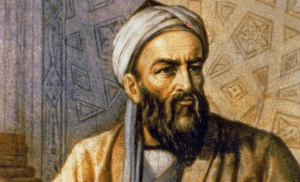
Abu Rayhan al-Biruni
Al-Biruni is likely to be the most remarkable figure from the Middle Ages and possibly the most neglected scientist throughout human history. With no calculators, telescopes, or satellites, he managed to determine Earth’s circumference to an accuracy of almost one-hundredth of one percent from what we know now, standing on top of a mountain in India using just trigonometry and a diopter. His measurements would not be confirmed by modern instruments until about 500 years later.
But that was just the start of this great man’s accomplishments. Al-Biruni published an impressive number of writings on astronomy, mathematics, pharmacology, physics, anthropology, linguistics, and history — an estimated total of 146 different volumes or treatises. Not only did he learn Sanskrit to read Indian literature directly from the original texts, but he was also the first person outside of India to write a complete history of Indian civilization.
Al-Biruni was advanced in his time. He theorized on his own that Earth rotates around its axis and orbits the sun, well over 100 years before it was accepted as a theory in Western science. He measured 18 distinct metals and gemstones to define their specific gravities with accuracy unknown until centuries later in the 19th century.
In essence, he encapsulates the true meaning of a universal scientist. He was a polymath without parallel; no other scientist during that period conducted scientific research with as much accuracy on this level as al-Biruni.
Calculated Earth’s Circumference
Proposed Heliocentrism Early 146 Books Across Disciplines First Scientific Anthropologist
Chapter 02
◆ The Question That Matters ◆
Why Were Their Names Erased?
Although this perspective may be perceived as conspiratorial by some, it is a genuine part of history. In the 12th century, the initial engagement of scholars in Europe with Arabic sciences began through the translation of Arabic scientific manuscripts, particularly in the town of Toledo, Spain, which had just recently been recaptured from the Muslim Moors. Two challenges that scholars encountered when translating Arabic manuscripts were political and religious.
While the Crusades were ongoing, there was a political need to convince Christian European scholars that they were not receiving important knowledge from their enemy, Islam. European scholars resolved this challenge by Latinizing the names of authors of the manuscripts being translated so that there was no direct correlation to the original author. Some well-known translations are Al-Khwarizmi to Algoritmi; Ibn-Sina to Avicenna; Al-Zahrawi to Albucasis; Ibn-Haytham to Alhazen. Knowledge has crossed the Mediterranean Sea. Credit has not passed along with it.
◆ The Uncomfortable Truth
Historian Ehsan Masood states, “Like many things, the names of Arabic origin … became lost in the myth of the Dark Ages.” The idea that science has come directly from Greece, through the Renaissance, without any of the 700 years in between, is not only false but was constructed in many cases to do so. The Islamic Golden Age was not a bridge between two civilisations but rather a civilised society in its own right; a society whose contributions were taken whole by the West and later re-credited to others.
This is not simply about ‘pride’ in morality or culture; it’s about understanding how knowledge is transmitted between cultures; it does not happen in a straight line but rather in a complex way through several different cultures, all trading and exchanging knowledge with each other, and the victors of those cultures rewriting their history to suit them.
Chapter 03
◆ The Deeper Question ◆
What Made the Islamic Golden Age Possible?
These five men may be seen as phenomenal individuals who just happened to be Muslims. This would be an oversimplification of a much larger issue. The five men did not create the Islamic Golden Age. The Golden Age was created through a system of interconnected cultural, political, and religious structures, which created a milieu in which curiosity was not only approved of but encouraged.
The revelation of Quran starts with the word iqra, or “read.” It encourages the reader to expand their knowledge and understanding. The theological view of the day held that investigating the natural world was an act of worship because it revealed the existence of God. The research conducted by scholars was financed because it was viewed as a religious obligation, and therefore, it was the government’s responsibility to pay the salaries and provide the support necessary for the scholarship. Libraries were available to all citizens as places to gain knowledge, and the right to question — or debate — the legitimacy of any particular piece of knowledge was supported by Islamic law.
The House of Wisdom was far more than a simple library; it functioned as a major intellectual center. It was an ideological construct built upon the premise that all truth — wherever that truth originated from — should have an equal chance of being discovered and therefore should all be pursued equally. All cultures, including the Greeks, Indians, Persians, and Babylonians, played a part in the creation of the Islamic Golden Age; it was a direct result of being part of the greater Islamic civilization.
“The Islamic world led in fields like mathematics, astronomy, medicine, and engineering for about 700 years — a period routinely neglected in Western narratives of science.”
Jim Al-Khalili, Physicist & Science Historian
The Mongol invasion of Baghdad (1258 CE) ended the Golden Age. The Mongols sacked Baghdad, burned down the House of Wisdom, and threw many volumes of books into the Tigris River, which colored the water black with ink. The last remnants of the Golden Age were extinguished by fragmentation, political instability, and a gradual closing of theological ideas.
The Real Legacy
Political motivation is not the terminology used to explain studies about reclaiming past glories – and ancient scholars from the era known as the Islamic Golden Age would not want it. Al-Biruni said truth does not have any boundaries based on nationality. Ibn al-Haytham would claim that the greatest honour in intellect would come from questioning something or someone, even if it’s an ancient authority.
There is really only one significant lesson to be learned from this “Islamic Golden Age,” a time when civilization recognized all forms of knowledge as valuable and worth preserving, no matter where they came from, and developed organized systems to collect, protect, and share that knowledge. The real lesson here is about what happens to civilization when they stop doing this.
Every time you perform mathematical calculations, read through a lens, take medication(s), or undergo a surgical procedure, you are living in an environment that was established by Muslim scientists and scholars and should therefore be recognized – both in the classroom setting as well as in terms of society as a whole – as an integral part of humanity’s evolutionary path. The impact these scientists and scholars had on our daily lives is immeasurable; they should be remembered and revered, and the foundation upon which their contributions were built should be fully appreciated by the entire world, not merely relegated to being thought of as just another historical footnote.
Hammad Akbar is a political science student at the University of Balochistan and the founder of Brainification Blogs — a platform dedicated to the rigorous and accessible exploration of philosophy, world politics, and the shifting contours of global power.His writing draws from a commitment to intellectual honesty: situating ideas within their proper historical and theoretical contexts, interrogating assumptions that often go unexamined, and arriving at conclusions through reason rather than reflex. Whether engaging with the philosophy of the state, the dynamics of geopolitical rivalry, or the moral questions embedded in international affairs, Hammad approaches each subject as an invitation for genuine inquiry."Not just what to think about the world — but how, and why."
A contributor to academic journals and newspapers, he understands that credibility is earned not through assertion but through the quality of one's reasoning. His readers find in his work a rare combination: analytically precise arguments without being inaccessible, and perspectives that are firmly held without being closed.Hammad believes that in an era of noise and rapid-fire opinion, the most radical act is to slow down, think carefully, and write with clarity and care.