
Aravind Srinivas Journey: From IIT Madras Hostel to AI Innovator. How Perplexity AI Became a Leading Artificial Intelligence Company
In 2015, a young man was working on his computer in a hostel of the prestigious IIT Madras in India. He was like all other students – using Google to find answers, learn, and explore the Internet. Little did anyone know that this young man, Aravind Srinivas, would go on to start a company that could challenge Google itself. He was also just a young man who came from a middle-class family in Chennai, India.
Early Passion for Technology and Machine Learning Breakthrough
After finishing school, he enrolled at IIT Madras and studied Electrical Engineering. While most of his classmates were having a good time in college, going to parties and exploring new experiences, Aravind was focused on something entirely different. He was fascinated by how computers think and make decisions, but did not have any concept of what machine learning was at that time. Nevertheless, his curiosity led him to enter a machine learning contest, where he won with very little preparation. This accomplishment was a significant milestone for him, allowing him to define his future.
From University of California Berkeley to Leading AI Companies: Building Expertise
Aravind began his Ph.D. studies at UC Berkeley in August of 2017 after migrating to the United States from India. In addition to completing his Ph.D., he gained valuable real-world experience through internships at many of the world’s leading artificial intelligence companies, including OpenAI, Google Brain, and DeepMind. Through these experiences, he came to realize that the future of information retrieval would be advanced artificial intelligence, not traditional search engines.
Limitations of Google Search and ChatGPT: The Market Gap
For many years, Google was the dominant force on the Internet, providing an endless list of links whenever someone typed a question. However, there was an industry transformation in 2022 with the release of ChatGPT.
ChatGPT allowed people to have conversations, ask unlimited follow-up questions, and expect contextualized, dynamic responses. Unfortunately, ChatGPT had many shortcomings — specifically, it did not return real-time information and did not include verifiable sources in its responses to user questions. Thus, trust issues began to arise with ChatGPT, leaving consumers to choose between using a link-driven search engine like Google, which provides immediate answers, or an answer-driven AI assistant like ChatGPT, which offers no verifiable sources.
Perplexity AI Growth Strategy: The Future of AI Search Engines
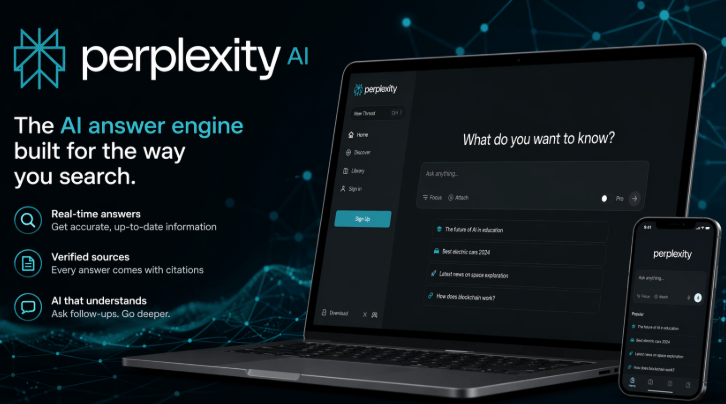
After realizing there was a gap in options that helped him answer questions with ease, Aravind decided to build something different altogether. Thus, he co-founded Perplexity AI in December of 2022, based on what may seem very simple at first glance – Create an AI answer engine/solution that combines both concise, immediate answers (actual “knowledge”) and verifiable sources of every single answer provided by using proven, credible reference links associated with each answer generated. This combined approach provides greater accuracy and creates trust amongst users – thereby making it different from other AIs available today.
The biggest initial challenge in building an advanced AI platform is cost. Building high-end models typically costs many billions of dollars, creating an almost insurmountable barrier to entry for most start-ups. In addition, rather than building an original model from the ground up, he deliberately and strategically chose to use existing, world-renowned models on his platform (i.e., GPT, Gemini, LLaMA). With these existing technologies, Aravind was able to create an “AI Aggregator” solution that took advantage of these three different technologies through API interfaces and was able to save substantially on expenses, not be dependent upon one model and create much quicker innovations to help users find the answers they need faster and more efficiently.
The launch of Perplexity (on December 7, 2022) received a wild response, with Perplexity initially receiving ~3000 queries a day. Within months, this grew to billions of queries monthly, resulting in an almost 1000x increase in a year’s time. Today, Perplexity has grown to producing over 30 million searches daily making it one of the fastest growing AI startup’s on the planet.
The rapid growth caught the attention of larger investors. Companies and individuals, including NVIDIA, Jeff Bezos, & SoftBank, have invested in building Perplexity and are expected to value the startup at ~20 billion by 2025. A level of growth like this is rare and continues due to the rapid pace of technological change.
Many people question why larger companies (e.g., Google or OpenAI) have not created a similar product. The answer lies in both companies’ overall business models. Google sells ads, and therefore, if they begin to provide users with direct answers, rather than links, its users will likely stop clicking through to websites and eventually cut Google off from ad revenue. OpenAI and Microsoft also sell large quantities of API’s for their AI. A neutral answer engine, such as Perplexity, would thus simply place Perplexity in direct competition with their own customers.
Your blog always leaves me feeling uplifted and inspired Thank you for consistently delivering high-quality content