
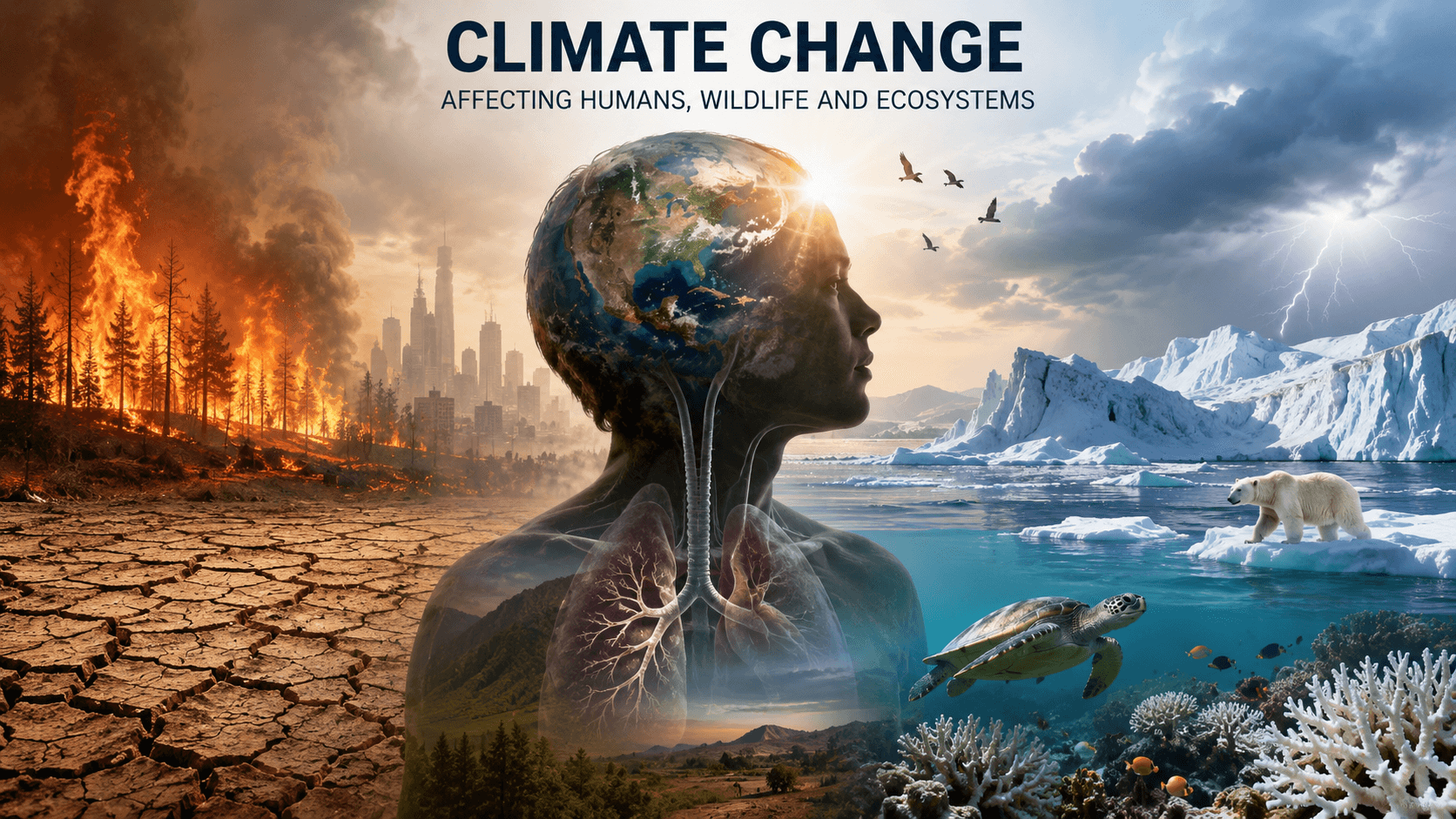
Warming Planet Is Changing Humans, Wildlife and Ecosystems
Scientists are questioning whether, as the planet warms, rapid environmental change will also change how the human body develops, functions, or adapts.
Climate Change and Carbon Dioxide
Ocean Acidification
Ocean Deoxygenation
For marine life, oxygen is necessary for their life just like humans.
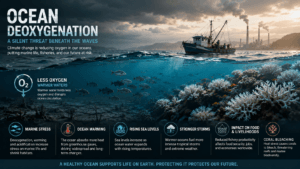
Ocean Warming (a Planetary heat reservoir under pressure):
The ocean absorbs a massive amount of heat that is released by greenhouse gases from the Earth. Ocean warming is causing multiple issues that include:
- Changes in marine ecosystems.
- Sea levels increase as ocean water expands with rising temperatures.
- Capacity of production of food and other services has been reduced.
- Tropical storms are becoming more intense.
- Fishes changes its geographical distribution.
- Coral bleaching
How a Warming Planet Is Affecting the Human Body
The human body has a limited capacity to maintain its internal body temperature.
Nutrition, Development and Biology
Climate change can damage crops, can disrupt fisheries, and can result in an increase in prices. Limited access to sufficient and nutritious food can affect:
- Physical growth.
- Immune function.
- Malnutrition.
- Pregnancy.
- Child development.
It doesn’t directly damage the DNA of the human body. Environmental changes can impact biological outcomes through disease exposure, nutrition, heat stress, and pregnancy conditions. Older people, children, and pregnant women are among the population being particularly affected.
Heatwaves (The Growing Threat to Health and Society):
Heatwaves are among the direct effects of climate change on humans. Extreme heat can increase the death rate quietly, especially in vulnerable populations. Along with this, working, farming, and traveling can be dangerous. Heat reduces labor productivity. Agriculture is also affected because agricultural workers, they have to work in outdoor areas for very long times every day. An increase in temperature directly affects where people will work, at what time, and how to design cities.
Global Impacts of Climate Change
Climate change doesn’t only produce one disaster; it creates multiple interconnected risks. For example, droughts will lead to less agricultural production, which will result in increased food prices; it will bring poverty and malnutrition, water security issues, health problems, and end in displacement. It means environmental problems bring other economic and social problems. It is called the cascading effect.
Economic Impacts
Climate disasters destroy roads, homes, crops, businesses, and infrastructure, which directly effects economy and brings economic loss. Indirect costs include loss of agricultural production, labor productivity, damaged supply chains, increased health care costs, increased insurance and disaster recovery expenses, losses in tourism and fisheries, and the cost of relocation and rebuilding.
Developing countries usually have to bear economic damage more than their incomes. It therefore not only threatens physical assets but also economical foundation that supports employment, development, and public services.
Climate Change in Africa
Africa is among the areas that are under the highest threats of destruction from climate change.
Even so, Africa produces very little greenhouse gas as compared to others. Increasing temperatures, extreme drought disastrously floods, and implausible rains have already affected millions on the continent.
Agriculture is especially affected because Africa mainly depends on rain-fed farming. Extreme heat and drought are destroying crops, killing livestock, and bringing a great increase in food prices, that eventually will end up on malnutrition. Climate change is producing severe health risks. The extreme heat can increase the water shortage, and changes in rain patterns can produce disease related to heat, such as malaria.
The economic consequences are equally serious. Governments spend more on emergency responses to disasters and rebuilding, which slows down investment in healthcare and education.
According to the IPCC and World Meteorological Organization, climate change is contributing to food insecurity, poverty, displacement, and ecosystem loss in Africa. Displacement numbers, according to UNHCR, are staggering.
Disruption In Ecosystems
An ecosystem operates through relationships between plants, animals, microorganisms, water, climate, and geography. Climate change is disrupting relationships between temperature, rainfall patterns, fires, and seasonal cycles. Biological responses include changes in physiology, changes in growth, abundance of species, geographical distribution, and changes in seasonal timings. Some species do not adapt easily, which causes restrictions in local losses, mass mortality, and ecosystem changes.
Rising Sea Levels
Global sea levels are rising for two reasons: warm seawater expands, and glaciers and ice sheets are melting and losing ice. Coastal cities, islands, ports, agricultural land, freshwater supplies, roads and infrastructure, wetlands, and coastal ecosystems are at the biggest risk. Saltwater can also affect drinking water by entering freshwater systems and agricultural soil.
Biodiversity Loss
Every species evolves under specific habitats, temperatures, and rainfall patterns. When these conditions rapidly change, species have three options: to adapt, to migrate, or face population decline. Extinction risk increases with increasing global warming. In the same way, ecosystem degradation and biodiversity loss are also major risks that are expected to surge with additional warming.
A scientific assessment by the joint IPBES-IPCC highlighted the close relation between climate and biodiversity. Healthy ecosystems can store and absorb carbon and can support adaptation, while ecosystem degradation can weakens the natures ability to reduce climate risks.
Impacts of Climate Change on Wildlife and Their Migration Patterns
Animals are already responding to climate change. Some species are moving towards higher latitudes and elevations, changing breeding seasons, and their migration timings and feeding patterns are changing. They have to face main cities, roads, fragmented habitats, physical barriers, and food shortages during migration, because migration is not always a solution.
Coral reefs are the biggest example; when ocean temperature rises to extreme levels, it causes coral bleaching and mortality.
Many animals use temperature and seasonal signals to decide where and when to migrate, reproduce, and to search for food. Climate change disturbs these signals. For example, a migratory animal reaches its traditional feeding ground at its usual time, but due to warming, its food source has already ended after appearing. It’s called timing mismatch, and it affects survival and the reproduction of animals.
Infrastructure damage due to Climate change
Modern Infrastructure was designed according to the historical climate conditions. It can damage roads, bridges, water systems, electrical networks, hospitals, schools, ports, railways, and housing. Floods can destroy transport systems. Extreme heat is pressuring roads and power systems. Rising sea levels are a threat to coastal infrastructure. Floods can contaminate water systems and increase health risks. When infrastructure fails, the consequences spread quickly.
Climate Change Adaptation Strategies
Adaptation is becoming essential for protecting human life, ecosystems, and the economy as climate changes. It is necessary to reduce future warming while lowering greenhouse gas emissions. But communities must also prepare themselves for impacts that are already unavoidable.
Adaptation strategies include making heat-resilient cities through building designs, cooling centers, green spaces, and early warning systems for heatwaves and natural disasters like floods. Farmers can adopt climate-smart farming techniques, improved water management, efficient irrigation, and drought-resistant crops to protect their food production.
As for the government, it must strengthen its infrastructure, like climate-resilient roads, water systems, and coastal infrastructure and flood defenses, while restoring wetlands, forests, and mangroves that naturally reduce flooding and protect biodiversity.
It will give communities enough time to prepare themselves against floods, drought, storms, and heatwaves through improved early warning systems.
Final Thought
Climate change is not the crisis among crises; it is a risk multiplier that intensifies the already existing environmental, societal, economical problems. The environment that shaped human civilization is rapidly changing, and now humanity has to adapt to a planet that is changing by itself.