

Author’s Note
AI is no longer just a single chatbot. In this evergreen article, I will provide you with 3 best ChatGPT tricks to increase your productivity. After reading the blog, your prompts will no longer be simple everyday prompts; you will get powerful outcomes with the help of these 3 ChatGPT Ideas.
Stop Using Artificial Intelligence Like an Intern: Here are 3 Best ChatGPT ideas/Strategies That Turn It Into Your Executive Team.
ChatGPT is a smart AI tool that will help you find answers in 2026. People use AI ChatGPT and other Chatbots (Claude, Google Gemini, etc.) as a smart intern. They often use it to summarize documents, draft emails, generate images, or content, and close it after doing their work. But it is a more powerful tool than you think if you use it correctly. Actually, you are holding a supercomputer in your hand, yet you are using it as a calculator.
During Research about Top ChatGPT ideas and strategies, I found that the elite tech firms use Artificial Intelligence for decision-making, not for task execution only.

The main advantage of Artificial Intelligence is not only its speed, but also its structured thinking ability.
When a user uses ChatGPT in a perfect way, it can sort many problems, like it has the ability to function as:
- A strategist
- A researcher for you
- decision-making coach for your company
- A smart learning partner
- And a cognitive mirror
Below are the three of the top strategies and best ChatGPT ideas that transform your AI chatbot into an outstanding and consistent thinking system.
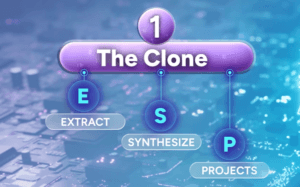
1. The Clone Strategy (First Idea)
ChatGPT often starts every conversation without knowing about your goals, especially these essential things: your tone of communication, your strategic priorities, your decision-making habits, and your blind spots.
You constantly need to explain the context again and again in each new chat, and it may be a bit annoying for the user. I also hate this.
To counter this annoying issue, we need to apply the ESP Framework Formula, which will help us to make our AI more productive, and it is a totally legal thing.
E — Extract
This step is raw cognitive capture. Avoid editing yourself.
Open the voice mode and let ChatGPT interview you for 10-20 minutes and analyze your personality. Tell him about your background, your working style, your strengths and weaknesses, your tone of communication, what your long-term goals are, and patterns of your strategic thinking.
And must remember that this step is a raw cognitive capture. Avoid editing the text yourself; let the AI decide what it wants to analyze.
S — Synthesize
After giving your detailed interview to AI, upload your transcript and ask ChatGPT to create your profile about your decision-making, Communication preferences, personal principles of how you operate things, default response formats, and known biases.
After doing this, paste the summary into the custom instructions. The custom instruction is an amazing and well-known feature of ChatGPT that allows you to provide custom responses of up to 1500 characters. ChatGPT always gives responses according to instructions and how you think, not like traditional AI responses, like what the average user thinks.
P — Projects
The third is Projects. The project is a space in the left corner of ChatGPT where you create a separate project and give it instructions.
For instance, upload a CV, PDFs, and pertinent data for your work projects. Within the settings of each project, you can even alter the instructions. Just don’t mix different domains. As an example, I have distinct projects for my health, YouTube, and consulting. Your AI becomes a permanent brain as a result of this. But that’s just the beginning. The heavy lifting still requires an army. That’s our next tactic.
2. The Swarm Strategy (Second Idea)
The swarm is the name of the second tactic.
In ancient Indian mythology, there is a well-known story about a demon that was next to impossible to beat with just a single weapon. As a result of all this, the great goddess appeared with eight arms, and each arm consist one weapon.
Ashtabuja Durga was her name, according to the mythology. Eight battles, eight arms, and eight weapons. And the majority of us are using only our two bare hands to battle our own modern demons.
Only one task at a time can be handled by our brain, as shown in the research of the National Library of Medicine.
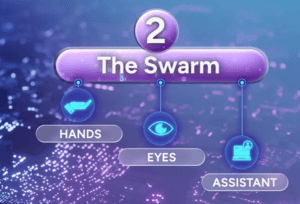
So, to become more productive You should use these three unique advanced features of ChatGPT.
- Your hands come first.
Quit working on each task individually. Make use of the agent mode. Forward at the swarm. Rather than looking for a single lead, command ChatGPT.
50 leads in the SAAS space. Check their emails. Sort them according to their revenue. That’s all. Let it run. You’re going to get coffee.
There is a catch, though. ChatGPT remains restricted to a text box. Although it can locate leads, it cannot enter them into your CRM or build a process around them.
- Your eyes are number two.
Quit talking about your issues. ChatGPT has a lot of visuals. You can snap a picture of a complicated analytics dashboard, a broken auto part, or a whiteboard sketch.
Simply upload it, say, “Analyze this picture. Tell me what’s wrong with it,” and let me know what I can do to make it better.
ChatGPT is more than just a keyboard; it’s your eyes. The best part is that ChatGPT can see things that are unnoticed to the human eye.
- Lastly, your research assistant comes in at number three.
You can do deep research that was once the domain of an analyst whom you would pay $50,000 for.
I recently met with the chief technology officer of a large company. And he made a really fascinating statement.
He stated, “I had to evaluate six presentations delivered by a very large IT consulting company on the technology infrastructure of a massive data center.” Additionally, the 300 pages contained a lot of information.
What did he do, though? He hired a swarm of AI analysts and uploaded them all to ChatGPT. It only took one afternoon.
Now, that would have taken weeks before. That’s the modern world we are heading into.
You won’t be charging for your time in the era of artificial intelligence. You will only be charged for what you like. Thus, you have an army of capable interns thanks to this swarm. But using AI to take orders isn’t our next tactic.
3. The Devil’s Advocate Strategy (Third Strategy)
The devil’s advocate is the third tactic that makes you productive using an AI.
The Catholic Church was the world’s most powerful institution in the 1500s. But it was also heavily attacked. The Pope had a serious problem by 1587. The church was canonizing saints left and right. Thus, the Pope took a rather drastic action. He founded the Devil’s Advocate, an advocacy office (Advocatus Diaboli), historically, this person was known as the Promotor Fidei.
This person’s whole job was to find the dirt, to poke holes, to be merciless, and to argue against the canonization of any saint. The church realized this 400 years ago. When the stakes are high, good decisions are rarely made through agreements. They come from conflict.
Now, why is this necessary? It is known as the “IKEA effect.” Anything we create ourselves makes us fall in love. According to research, intelligent people are excellent at identifying flaws in other people’s thinking, but they are physically unable to recognize them in their own. So the key insight is that most people use ChatGPT for validation, but you should use it for violation.

Here’s the issue, though. ChatGPT is designed to make you happy. Therefore, you must make it act differently. So, here are the three tricks to break the AI’s people-pleaser programming.
First, use magic triggers. Force adversarial thinking. Instead of saying, “What do you think?” be specific. Prompt it and say, “Audit this using first principles, or act as my fierce competitor. Your needs will be met, even if you don’t get what you want.
Next is shadow boxing. Never enter the ring unprepared. Let’s say you are going out to raise money for your venture. Tell the AI, simulate a debate between a ruthless, skeptical VC and a visionary product designer. Allow the VC to challenge the idea. I want to see that fight and learn from it. This way, you let AI expose the weak points so you don’t fumble on them in a real-world meeting.
Third, the blind spot check. Feed it your strategy and ask one question: based on what you know about me, what are the gaps in my reasoning? Whenever we achieve success, we develop two unhealthy habits. We trap ourselves in this bubble of our ego, and we surround ourselves with people who just say yes. That’s why this strategy is so critical to save you from yourself. But knowing where you’re wrong or why you’re wrong is not enough. You still have to learn fast about what’s right.
Final Critical Thoughts About ChatGPT and AI
After reading this article about ChatGPT, an important question may arise in your mind: “If you are giving an interview to AI about your personal information, goals, and strategies, will ChatGPT steal your ideas and strategies and later deliver them to someone else?”
The clear answer is no, because the algorithm of Artificial Intelligence is built to give answers to your questions and to learn more every day from users’ questions and responses, thereby increasing the accuracy of its results.
The world is progressing rapidly every day, and new technologies are being invented. So, learn AI before everyone dominates and you get left behind.