
Table of Contents
ToggleEvery Country Is in Debt — Here’s Why That’s Not Always Bad
The Majority of Countries Are in Debt.
Most of them (immature economies) and advanced economies—including India, Pakistan, Qatar, the USA, and Japan—all borrow as much as they spend.
Example No.1:
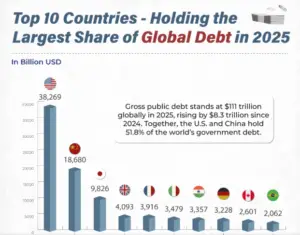
Japan will have a debt that is approximately 200% of Gross Domestic Product. Japan’s GDP is estimated to be $4 trillion, while Japan’s total debt is estimated to be approximately $9 trillion.
Example No.2:
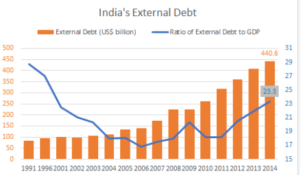
India has a similar ratio of debt. India’s debt equals approximately 80% of its GDP.
The total amount of Global Debt would be roughly 2.5 times the total Gross Domestic Product (GDP) of the entire planet.
Loans to governments are now so common that the conversation has shifted. Instead of primarily discussing the total amount of national debt, attention is now on how much additional borrowing occurs each year—known as the fiscal deficit.
From a Personal Financial Perspective, a Debt is shocking and therefore a negative. However, on the Macro Level, not all National Debt is bad.
This article will help us learn:
- The reason(s) for Government Loans
- Sources of Government Loans
- How Governments Manage Their Debts
- What the future looks like for countries buried in loans

How Governments Earn and Spend Money
Every government functions like an organization. It earns money and spends money.
Government Income Comes From:
- Taxes
- Revenue from investments
- Profits from PSUs (the government-owned companies)
Government Spending Includes:
- Infrastructure investments
- Salaries of government employees
- Subsidies and welfare schemes
- Free ration and public services
Government expenditure almost always exceeds government income worldwide.
Then how do governments manage this gap?
By borrowing money.
To understand how countries bridge this gap, let’s define the concept of national debt.
The total loan taken by a country’s central government is called:
- National Debt
- Sovereign Debt
- Public Debt
Huge amounts of loans can be issued by the various states within a country, independently, such as for financing an expensive metro system/rail system. Many of these loans will come from multilateral development banks like the World Bank and Asian Development Bank; these loans will not be included in the National Debt.
India’s Debt Situation:
- Central government debt: 50–60% of GDP
- Total debt: Up to 80% of GDP, including states
This ratio is called the Debt-to-GDP Ratio, and it is an important indicator of economic stability.
Key insights:
The number itself matters less than how fast it is increasing or decreasing.
Japan’s debt-to-GDP ratio exceeds 250%.
The USA’s debt is also extremely high.
The USA’s debt is also extremely high.
So, debt alone does not decide whether a country is developed or not.
Fiscal Deficit Explained Simply
When a government has more expenditure than it has money, the amount left after subtracting expenditure from revenue is called the fiscal deficit.
The Government fills this gap by borrowing money. In India, the fiscal deficit is usually between 4% and 6% of GDP for each financial year.
The real question is:
What will the Governments do if their revenue is always less than their expenditure? How will Governments ever repay their debts with that?
Why Governments Don’t Just Cut Spending or Raise Taxes
Option 1: Cut Spending
- Fewer projects
- Less money in the market
- Job losses
- Economic slowdown
- Public anger and protests
Option 2: Increase Taxes
- Less money in people’s hands
- Lower demand
- Reduced production
- Economic slowdown
- Again, public protests
So governments try to balance both, and borrow the remaining amount.
Debt for Development: Why Borrowing Is Necessary
Big projects like:
- Bullet trains
- World-class highways
- Power plants
- Metro systems
require a huge amount of money upfront.
Just like individuals take home loans instead of saving for 30 years, governments take loans to build infrastructure quickly.
The important rule is simple:
If the return from the project is higher than the loan’s interest rate, the debt is good.
Bad debt is when loans are taken for:
- Luxury projects
- Corruption
- Paying interest on old loans only
Ultimately, taking out additional debt simply to pay interest can lead to a debt trap, a country continuously taking on more debt to pay for its existing debt. An example of this is the recent economic collapse of Sri Lanka in 2022.
Emergency Borrowing
Governments are sometimes forced to borrow during:
- Pandemics
- Wars
- Natural disasters
- Famines and droughts
In such cases, borrowing is unavoidable.
Who Lends Money to Countries?
1. Citizens (Through Bonds)
Governments issue bonds, promising:
- Fixed interest
- Repayment in the future
These bonds are bought by:
- Individuals
- Banks
- Mutual funds
- Foreign investors
They are considered relatively safe investments.
2. Foreign Governments & Institutions
Countries borrow from:
- Other nations
- World Bank
- Asian Development Bank
These loans are used for development projects and come with conditions.
Example:
Sri Lanka borrowed from China to build Hambantota Port. When it couldn’t repay, China took control of the port.
Sri Lanka borrowed from China to build Hambantota Port. When it couldn’t repay, China took control of the port.
3. IMF (International Monetary Fund)
The International Monetary Fund provides emergency loans, not development funding.
Conditions include:
- Cutting government spending
- Raising taxes
- Reducing subsidies
- Privatizing public companies
In some countries, this helped.
In others (Greece, Argentina), it worsened the situation.
In others (Greece, Argentina), it worsened the situation.

4. Central Bank (Printing Money)
Governments can borrow from their central bank (like the RBI), which prints new money.
This is called debt monetization.
But this causes:
- Currency devaluation
- Inflation
Zimbabwe is the classic example of why this is dangerous.
Is Debt Good or Bad?
Debt is bad if:
- It is unplanned
- It funds waste or corruption.
- It only pays old interest.
Debt is good if:
- It funds growth
- It increases productivity
- Economic growth exceeds interest rates.
Unlike individuals, countries are considered eternal.
They are not expected to repay the principal—only to keep paying interest and maintain credibility.
They are not expected to repay the principal—only to keep paying interest and maintain credibility.
Why Countries Lend to Other Countries?
Often, loans come with conditions that benefit the lender.
Example:
If Japan lends money to India for a project, it may require India to buy Japanese components.
If Japan lends money to India for a project, it may require India to buy Japanese components.
This helps:
- Japanese companies grow
- Jobs increase in Japan.
- Technology eventually transfers to India.
So both countries benefit.
Conclusion
Every country tries to ensure that:
Economic growth > Interest rate on debt
When this fails, countries fall into debt traps.
When managed well, debt becomes a tool for progress, not destruction.