
Norway Is Quietly Moving Toward Becoming the Richest Country in the World
When Russia invaded Ukraine, it disrupted Europe‘s energy supply. Many countries across Europe went in search of new sources of energy, looking to replace their dependence on Russian oil and gas, and Norway quickly became the best option for Europe to turn to as a dependable source of energy. Accordingly, Norway‘s petroleum exports skyrocketed almost five times higher than before the Russian invasion; hence, Norway became Europe‘s largest energy supplier.
Yet again, Norway acted as it has historically been successful in doing; rather than spending the additional income generated from this increased energy supply, it reinvested the revenue earned into the Government Pension Fund Global (GPFG) or the Norwegian Sovereign Wealth Fund. As of today, this fund has a value of approximately $1.5 trillion, which translates into about $70,000 per person residing in Norway.
But Norway did what it has always done best: instead of spending this windfall, it invested it. The extra profits were added to Norway’s Government Pension Fund Global, commonly known as the sovereign wealth fund. Today, this fund is worth around $1.5 trillion, which translates to roughly $70,000 per citizen.
Then, something even bigger happened.
A Discovery That Makes Oil Look Small
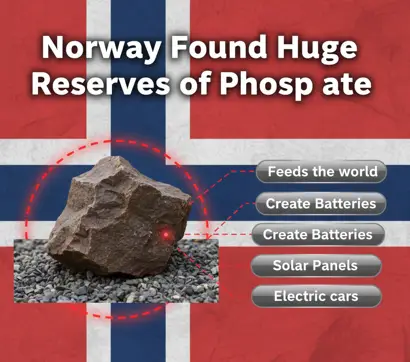
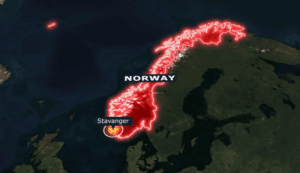
In 2023, Norwegian geologists made a remarkable discovery south of Stavanger. Beneath the ground lay that could be the largest phosphate rock deposit in the world—around 70 billion tons.
Phosphate is a rare and essential mineral. It is critical for:
Fertilizers that feed the global population
Batteries and solar panels
Electric vehicles and modern electronics
Around 70% of the global phosphate supply comes from Morocco, along with China, Egypt, and Algeria. Since these countries are in geopolitical hotspots, Western nations rely heavily on them but do not have control over them.
Norway Was Never Truly Poor
There is a common myth that Norway was poor before oil. In reality, Norway was not poor—it was simply not globally influential.
By the early 20th century, Norway already had:
High literacy rates
Low-income inequality
Strong democratic institutions
Norway also learned early how to use its geography. Mountains and rivers were converted into hydropower, providing cheap electricity long before oil was discovered. This allowed industrialization to begin decades earlier than many people realize.
Oil Came, but Norway Played It Differently
During the early 1960s, oil was discovered in the North Sea off the coast of Norway. Unlike many nations that have an abundance of resources, Norway took a conservative approach; rather than selling out its resources to foreign companies, it developed its own capabilities.
In 1972, Norway formed Statoil (now known as Equinor) and began educating its own workforce and building its own oil refineries, enabling it to control oil production. This proactive approach completely changed things for Norway.
Most nations with an abundance of natural resources tend to experience what economists refer to as a “Resource Curse,” characterized by corrupt practices, wealth inequality, and underdeveloped institutions, often stemming from the abundance of resources.
However, Norway was able to completely avoid the effects of the Resource Curse. A wealthy oil elite did not emerge, and oil profits were maintained by the public.
Saving for the Future, Not Spending the Present
By 1990, Norway faced a critical question: what should be done with all this oil money?
The answer was the Government Pension Fund Global. The rule was simple:
Save all oil revenues
Spend only the returns
Limit government spending to about 3% per year
By 2023, the fund had earned roughly $380 billion in investment returns, most of which remains invested for future generations.
Today, oil and gas account for about 20% of Norway’s economy—important, but not dominant. Diversification came early.
Phosphate: The Next Strategic Resource?
History suggests that technology eventually catches up.
The Bigger Picture
Norway’s success was made possible with its oil reserves. Phosphate may provide yet another avenue for Norway to obtain great wealth.
Norway has needed to remain patient, disciplined, and build strong institutions to sustain its continued pursuit of wealth. When Norway has consistently maintained these characteristics, it has been able to achieve the opportunity to become the first country to acquire massive amounts of wealth while retaining its institutional structure intact. If this happens, then it would constitute Norway’s greatest gift to the world.