
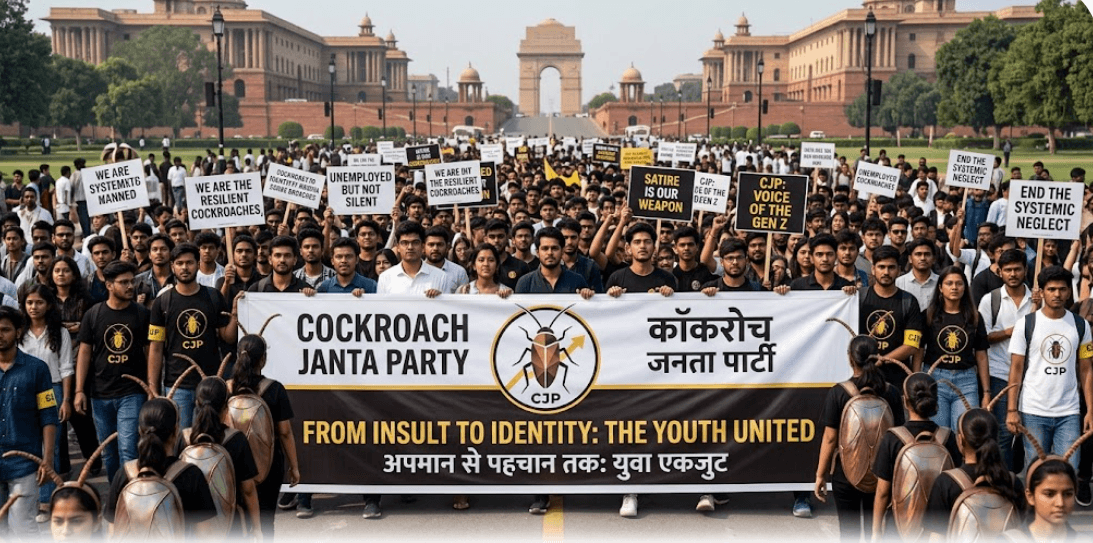
Cockroach Janta Party: Viral Rage or Real Political Force?
Every decade or so, India sees the emergence of a movement that causes the political establishment to sweat — from JP Narayan’s Total Revolution in 1974 to Anna Hazare’s anti-corruption crusade in 2011. Each time, these movements have been widely praised by analysts, amplified by the media, and joined by millions of individuals. Shortly thereafter, each of these movements either faded away, largely unnoticed, or was incorporated into the very political system they had challenged.
The Cockroach Janta Party (CJP) emerged from this unpredictable lineage. On May 16, 2026, one day after Chief Justice Surya Kant referred to unemployed Indian youth as “cockroaches” and “parasites of society,” the Cockroach Janta Party reached more than 20 million followers on Instagram within five days — faster than either the BJP or Congress.
However, the question that most articles on this movement do not ask is whether any of this will actually mean anything in terms of Indian politics. Specifically, will the CJP influence the outcome of the 2029 elections, or will it become nothing more than a clever meme that just didn’t age well?
This is not a “feel-good” piece about the CJP but rather an assessment of its true political significance, what vulnerabilities it has, and what forces are beginning to work against it.
1. The Systemic Anger Is Real — But Anger Alone Has Never Won an Election in India
To be clear about the number of young people in India, there are 360 million young people aged 15 to 29.
Azim Premji University published a 2026 report finding that 40% of young graduates aged 25 or younger are unemployed.
This is not an anomaly. This is a failure that will affect us all as a society, and it is right in front of us.
CJP’s five demands—remove Rajya Sabha seats for retiring chief justices; prosecute those who delete votes under the UAPA; give women 50% of parliamentary seats; revoke the media licences of Ambani- and Adani-owned media; impose a 20-year ban on political defectors—are interconnected. Each demand addresses a specific issue within India’s democratic system.
“Five years ago, people were afraid to speak out against Modi or the government. The times are
changing.”— Abhijeet Dipke, CJP Founder
The reason this quote is important, rather than the fact that Dipke expressed it, is due to the fact that the person who said this is a political communications strategist who has worked previously for the Aam Aadmi Party and who understands how the mechanisms of power operate. The Overton Window of India is transitioning. The question will be whether the Cockroach Janta Party (CJP) is a catalyst for that shift, or simply present at the point of change when it occurs.
2. The Hype vs. Reality Gap — And Why It Is Dangerous for CJP
The numbers that social media produces versus the numbers produced through the election process are two very different types of currency in Indian democracy, and that’s where brutal accuracy is needed the most. There are about 970 million voters in India, and there were approximately 640 million people who participated in the general election in 2024. A large portion of those 640 million people are from rural areas where the internet does not exist, there is a high level of chronic unemployment, and there is little to no Instagram activism. A person voting for the first time from rural Bihar or rural eastern UP is not following @cockroachjanata.india.
The Anna Hazare movement in 2011 is the best example to compare with because it generated a huge amount of urban energy in a short amount of time, filled Ramlila Maidan, and was very effective in shaking the Congress-led government to its core. It also created a new political party (Aam Aadmi Party) that went on to win the Delhi State elections. However, it took years of very hard work at the local level to accomplish this (several thousand booth workers), plus an overwhelming number of urban voters in a single state capital.
The Cockroach Janta Party has mostly been a digital movement up until now and has no recognized ground-level organizational structure. This is something that even those who have sympathies towards the movement recognize. The CJP has done creative actions (clean-up drives, costume protests – both of which demonstrate creativity), but creativity will never replace a base of workers.
The Dual-Edge of the Cockroach Symbol
Political symbols are laden with implications, and what the founder intended may not be the only meaning attached to them. The cockroach recaptures an insult amazingly — as did Quakers, Suffragettes, and LGBTQ+ movements worldwide — yet in the Indian public’s mind, it also carries the traditional images of dirt and decay. During campaign rallies in rural areas, the opposing parties — the BJP or Congress — will use that invocation of the cockroach without apology and with a similar amount of malice against each other. These are not conjecture, for this is how Indian politics has been conducted since there have been political parties in India.
3. BJP’s Most Likely Move: Co-option, Not Confrontation
Here’s the awful truth: the BJP is not going to crush the Cockroach Janta Party; there’s no reason to, as far as they’re concerned. Their most intelligent tactic is simply to absorb that sentiment; political analysts are already concerned about that very real possibility.
The BJP of 2026 will be completely different than the upper-caste BJP of the 1990s (the late ’90s, specifically). With the re-election of Modi — an OBC leader — to his third consecutive term, they’ve shown they can absorb political movements and neutralize their energy through symbolic concessions while redirecting popular anger towards external enemies.
This will be a familiar playbook; You can expect someone representing the BJP to nod their heads and acknowledge “the frustration of youth in India.” You can expect some kind of renewed push on unemployment schemes with a new face. You can expect that the BJP’s social media cell – one of the most sophisticated in the world — will have counter-memes within weeks of the release of CJP material. The goal is not to “win” the argument with CJP but to help CJP feel unnecessary.
The BJP does not need to fight viral movements. It
needs to make them feel like they already won
something — and then move on.
The Jan Lokpal movement ended; the genuine enthusiasm and positive energy from the Jan Lokpal movement was transferred from Arvind Kejriwal to AAP; the Congress party passed a watered-down version of the Lokpal Bill; and by two years after the Jan Lokpal Movement, the tide of national anger against political corruption had largely died down (this is because there are still many instances of political corruption, but political parties were able to manage that political discontent successfully).
4. The Opposition’s Bigger Problem: Cockroach Janta Party Exposes Their Own Failure
India’s opposition parties, especially the Congress Party and the INDIA coalition, should feel extremely uneasy. CJP’s meteoric rise isn’t just a critique of the BJP’s governance but also a direct indictment of the opposition’s failure to channelise the anger of youth into political activity.
The Congress has digital operations and runs social media campaigns, but no digital work done in 2025 or 2026 has generated even 1% of the organic engagement that one 30-year-old Boston University graduate’s X post received in 24 hours. This indicates a structural failure, not a messaging failure.
The opposition’s relations with Cockroach Janta Party present a unique challenge. If they formally align with CJP, they run the risk of appearing opportunistic while the CJP founder and spokesperson are savvy enough to distance themselves from established political parties but attempting to do so will cost the opposition their moral authority by leaving the door open for a satirical political movement; and if they oppose Cockroach Janta Party, they represent exactly the kind of institution which employs the term “youth cockroaches.”
5. Three Scenarios for Cockroach Janta Party’s Political Future
Scenario A: The Bangladesh Model (Low Probability, High Impact)
In 2024, a student-led rebellion in Bangladesh caused an upheaval in the government of Sheikh Hasina; tens of millions of people participated in what would go on to be recognized as one of the largest political earthquakes in history. Fellow students showed their activism in Nepal, where rapper-turned-politician Balendra Shah was elected into office with the help of the youth of the nation.
If Cockroach Janta Party creates a connection between digital outrage and organized street pressure, and if there is a distinct point of contention (a disputed election, a large corruption event, or a judicial crisis) that ignites mass participation in protests, this might prove to be a truly revolutionary action. There Is Currently No Condition Preventing This From Happening, Other Than Just Being Not Present.
Scenario B: The AAP Model (Moderate Probability)
Cockroach Janta Party was birthed through a grassroots movement and survived to become a governing party, in the form of a state party. With hard work (non-automated work), if they want to become as AAP did, so must Dipke and company become a regular “party” entity with registration, organizing at the booth level, and training of candidates. Being successful will require CJP to become everything it stands against in order to reach its goals.
Scenario C: The Flash-in-the-Pan Model (Highest Probability, Near-Term)
India’s social media world is a fast-moving environment where attention is the most limited resource. The same virality that has made Cockroach Janta Party successful will also be its biggest downfall when the next controversy arises; each new controversy will arise about every 12 news cycles (on average) within India’s political sphere – so CJP’s 20 million followers will scroll by quickly when this happens. The future of the CJP will be entirely dependent on the ability of the founder to create institutional loyalty through engagement before this happens; based on previous experience, this time frame appears to be measured in months, not years.
6. What CJP Gets Absolutely Right (And What Its Critics Are Missing)
One group of urban progressives has criticized Cockroach Janta Party as being composed exclusively of middle-class members who have only recently become aware of systematic inequalities when they have felt them from their own experiences. In an Instagram post that has gone viral, one user summed it up succinctly by stating: ‘CJP is just another group of people from an affluent urban centre becoming aware of how abusive and cruel the state apparatus is not only to those in the outlying areas, ensuring that they’ve created a system that is capable of victimising them, as well.’
There is indeed some validity to that critique; in a number of ways, Cockroach Janta Party’s overall membership criteria (unemployed, lazy, and incredibly connected on the internet) primarily appeal to an urban population who possess the ability to access digital technology. At this point in time, there has been little articulation or vision from either CJP’s leaders or members for the informal workforce, the rural agricultural worker, and the vast majority of 600 million Indian adults who are not on Instagram.
What critics are missing, however, is that if you look at other movements throughout history, they don’t start off with clear moral goals; they start where they have the most power. With the anti-CAA protests, the initial response came from Muslim communities before spreading throughout the country; farmers’ protests in Punjab began as local protests before spreading throughout India. If CJP’s leadership is serious(about their strategy), the urban middle-class base is a launch pad and not a limitation.
Final Verdict: Not a Party. Not Yet a Movement. Definitely Not Hype.
The Cockroach Janta Party will not win in the 2029 Lok Sabha elections, and this will almost certainly happen, as it is not registered with the Election Commission. The party does not have any booth-level workers; there is no alliance structure; there is no leadership pipeline at the state levels; and there is no response to the 600 million rural voters who will ultimately determine who governs India next year.
Calling CJP hype distorts how you understand it as a political pressure and accountability mechanism created through a Chief Justice’s disregard for young people. It has changed the way dissent is viewed when, per Dipke’s observation, speaking out against the government is seen as dangerous.
What is more valued than CJP surviving is whether CJP’s creation was the result of a sustained level of anger, and what happens to that anger once CJP’s Instagram account stops trending. India’s graduate unemployment is 40%; it will not be addressed between news cycles; it will be a long-term issue. CJP is merely one of the loudest alarms generated by this persistent structural crisis.
Movements within Indian Politics usually do not provide an exact prescription to cure the illness, for they are often not the ones who administer the cure. However, at a minimum, these movements will alter the existence of the ill; They affect the commitments by politicians, they alter the electorate’s sense of acceptable leadership. And they often lead to a complete transformation of the governing body (as shown by examples in both Bangladesh and Nepal).
The cockroach’s most famous quality is not its bite. It
is its survival. Whether CJP survives is secondary to
whether the injustices that created it do.
Author’s Note:
This analysis draws on reporting from CNN, NBC News, Foreign Policy, The Week India, Scroll.in, and Wikipedia’s documented sources. It reflects independent editorial opinion on publicly reported events and should be understood as political analysis, not party endorsement.