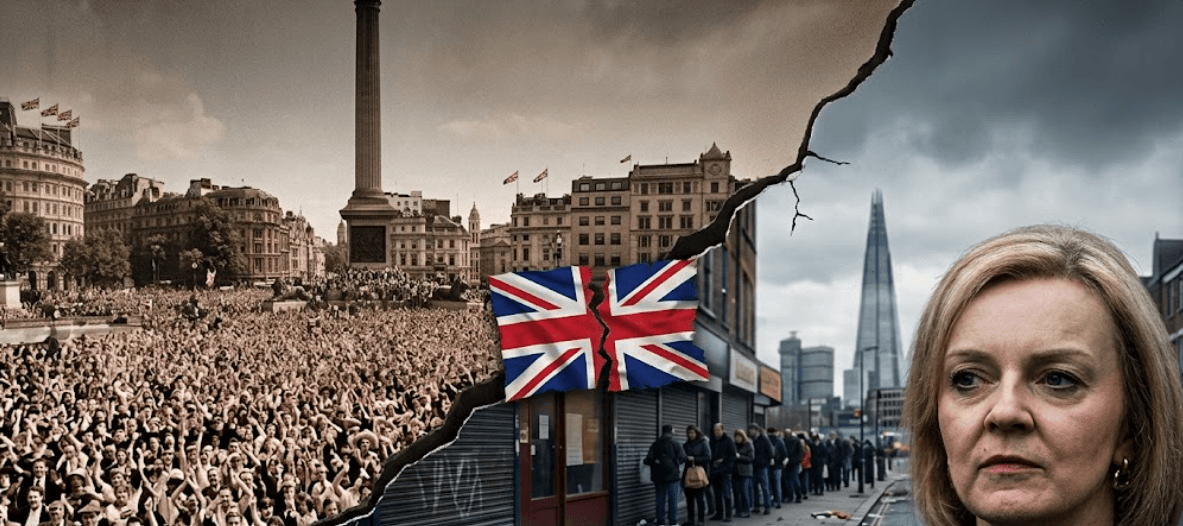
The Empire That Broke Itself: How Britain Went from Superpower to Crisis State
At its peak, Britain produced 20% of everything on Earth, ruled a third of humanity, and wrote the rules of global trade. In 2026, it had six prime ministers in nine years, a bond market on the edge, and no political majority that could govern. This is the story of three decisions that turned the world’s oldest democracy into an ungovernable state.
This past September 2022, a UK newspaper set up a live-streaming event showing the fate of a head of lettuce during a government “shake-up”. The editorial team of that newspaper asked the world if UK Prime MinisterLiz Truss would still be in office after 49 days when this event took place. The lettuce lasted longer than Truss did (she resigned on day 49), and it was never asked by the broadcaster, ” How did the United Kingdom become so incapable of electing a new Prime Minister or providing a stable government to support the majority of its citizens?
The ultimate purpose of this document will not be to just tell the story of a Prime Minister’s chaotic exit from office, but rather to present an account of how a nation that had maintained control of half of the globe has made 3 cumulative “policy mistakes” that will keep them locked inside an unresolvable crisis that they cannot vote, borrow, or cut out of. To the Pakistani and South Asian audience viewing from a distance, there are many parallels to the recent developments in Pakistan that will likely resonate too closely at home.
From Workshop of the World to 2% of Global Manufacturing
To truly understand how far Britain has fallen, one must first grasp how high it once was. At the peak of the British Empire, this small island produced around 20% of the world’s manufactured products. It controlled the naval shipping lanes of the world, it created the world’s reserve currency and established the rules for global trade – and it enforced them with the largest naval force ever amassed by mankind throughout history.
The British Empire ruled over more than one-third of the world’s population – from Canada to India, from Australia to Nigeria, the British Crown has been governing approximately 1.2 billion people. The British not only ruled an empire but also created the economic system used throughout the modern world. The steam engine, factory system, commercial banking, telegraph, and modern stock market – all British. The Industrial Revolution was not a worldwide occurrence.
It started with one country, Great Britain, and was later adopted by the rest of the world. The copycats were Germany, the U.S.A., Japan, and later China, and all would eventually industrialise at such a rate and volume that Britain would see its share of world manufacturing collapse from 20% to only 2%.
This was over the course of 150 years — a gradual and managed decline, and a natural result of competitors catching up to them. Great Britain remained wealthy and maintained a strong global influence, with its institutions (Parliament, the rule of law, the BBC, and the NHS) held in high regard around the world. In 2016, however, there was a political upheaval in Britain that created a structural crisis out of what had formerly been a gradual and managed decline.
Brexit: The Self-Inflicted Economic Wound
When the United Kingdom voted to leave the EU on June 23, 2016, many economists considered this event to be one of the most significant instances of economic self-harm perpetrated by a major democracy in peacetime history.
To understand why this happened, we must examine what membership in the European Union has meant for Britain. After joining the EEC in 1973, Britain benefited from free trade and free movement of goods with EU member countries, making it possible for a clothing manufacturer in Manchester to ship goods to Munich as quickly and easily as if they were being shipped to Birmingham, and enabling a financial services company in London to passport its licenses into 27 EU countries overnight. By 2016, approximately 42% of all British exports went to EU member countries.
The years between 2010 and 2016 were the time when the political narrative of the UK having a large net contribution to the EU was formed. The final calculations clearly show that immigration, sovereignty, and red tape all played a role in convincing voters to leave on 23rd June 2016, when 52% voted to do so.
But the departure has not created an independent economy. A manufacturer with whom I was working from Manchester now requires customs declarations, origin certificates, VAT registration in multiple countries, and physical border checks. For small/medium organisations exporting from the UK, the burden of these administrative requirements has been too much; as a result, many of them have stopped exporting into Europe.
The economic impact is now well established. Independent studies have concluded (now) that the UK’s gross domestic product is about 6% smaller than it would have been had it remained a member of the EU, at a cost of tens of billions of pounds per year. Additionally, there have been significant declines in trading volume with the EU, coupled with large segment shifts in foreign direct investment. In addition, financial services firms have moved their licences to Dublin, Paris, and Frankfurt.
Brexit’s pain is undeniable. However, it is only one part of three crises occurring almost in proximity to each other.
The Invisible Government: How Bond Traders Removed a Prime Minister
There are two distinct governments in every nation. The first one is visible and can be recognised by voting through the Prime Minister, Parliament, and televised political debates. The second form of government, which is less visible, consists of traders, investors, pension funds, and hedge funds that own the debt of the country. This government will not write letters of complaint, nor will they organise protests. They will simply sell if they disagree with the government’s financial policy.
Bonds are of great value in understanding how this invisible government operates because the government does not collect enough taxes to cover the total expenditure made by it each year. Thus, bonds (IOU’s issued by the government) are issued in order for the government to borrow the difference. An example of a simple bond would be as follows: lend me £1 million now and I will pay you 3% interest for 10 years, at which point I’ll give you back your original lending amount, i.e., 1 million £.
The greatest power of the invisible government occurs when investors become frightened and sell their bonds for pennies on the dollar. If an investor purchases a bond with a par value of £100 for £100 and it has a fixed annual coupon (interest) payment of £5, there is 5% yield derived from the bond. If an investor sells that bond for less than £100—let’s say £50—and that same bond will still pay the annual interest of £5, then the yield has been doubled from 5% to 10%.
In the case of bonds, when the price of a bond increases (and bond prices are always going to increase), the yield of that bond will decrease, and vice versa. Secondary market yields for bonds set the interest rate on all new government loans.
If the yields in the secondary market are 5%, then the government cannot issue a bond at 3% because no one would buy these bonds when they could get a better return of 5% via the resale market. The government must, therefore, match or exceed the current rate of return in the market; yielding higher rates makes it more expensive for the government to borrow any additional money.
This is exactly what occurred in September 2022 when Chancellor Kwasi Kwarteng presented his “mini-budget”, which included £45 billion of unfunded tax cuts. It did not generate any new revenues for the government, it did not include any cuts to spending, and it was funded through debt. The reaction from the bond market was instantaneous and dramatic.
UK government securities with long durations saw yields increase from 3.5% to in excess of 5.0%, within days of this announcement. The value of the pound fell. The pension funds in the United Kingdom that held substantial amounts of government securities as collateral faced margin calls, which could have potential forced sale issues.
The Bank of England responded with an emergency bond-buying programme to try to avert the insolvency of the pension funds. The Chancellor was dismissed from his position.
The mini-budget was revoked entirely. And 49 days after being appointed, Liz Truss became the shortest serving Prime Minister in the history of the United Kingdom — not defeated, as has happened historically through an electoral process, but defeated by a spreadsheet.
The Doom Loop Britain Cannot Escape.
You might believe the bond market’s fast response to bad fiscal decisions is an overall good thing – a natural limit on the government bankers like to call an exaggerated measure of fiscal policy. The problem is that Britain is in a continuing debt cycle, and those same limits, the bond market, are working against as well as holding them in place.
THE UK DOOM LOOP — FIVE STEPS TO PARALYSIS
Britain carries a mountain of debt
roughly 96% of GDP, the highest level since the early 1960s, accumulated across 2008, Brexit, COVID, and the energy shock.
High debt makes investors nervous.
They demand higher yields to keep lending — a risk premium on every pound the government borrows.
Higher yields raise the interest bill.
A debt of £100 billion at 2% costs £2 billion annually. At 5%, that same debt costs £5 billion — £3 billion extra, every year, just because traders sold paper.
To pay rising interest rates, the government borrows more.
The debt pile grows. Bigger debt crowds out investment in education, infrastructure, and healthcare.
Bigger debt makes investors even more nervous.
Yields rise further. The loop tightens. Return to Step 1.
The United Kingdom finds itself in a frozen state at the crossroads of two deadlocked paths of escape:
1. Invest and grow your way out of your predicament; however, the bond agency will not allow you to continue borrowing money.
2. Cut spending and raise taxes- however, fiscal trimming away from the economy results ultimately in slowing down growth rates, less tax revenue than previous periods of time, and a potential for a significant voter backlash similar to what happened to the Conservatives in 2024.
The outcome for the UK is seen in the number of patients on the NHS’s waiting list, schools are not able to find enough teachers, and local councils (the agencies that supply funds to support public libraries, social care services, and maintain roadways), in many cases, are in bankruptcy.
In addition, much of the UK’s public infrastructure is visibly deteriorating. The UK created the modern-day hospital system, but it cannot recruit sufficient staff for its hospitals.
The Numbers That Tell the Real Story
6 PRIME MINISTERS IN 9 YEARS (2016–2026)
96% UK PUBLIC DEBT AS % OF GDP (2024)
−6% GDP LOSS VS. EU MEMBERSHIP
74K NON-DOM RESIDENTS IN UK (PEAK, 2024)
16.5K MILLIONAIRES WHO LEFT THE UK IN 2025 ALONE
49 DAYS LIZ TRUSS LASTED AS PM
It is easy to see that there is a lot of political fragmentation. The results from the May 2026 local elections illustrate this well: no single political party received more than 30% of the votes in any of the election districts. The numbers were as follows: Reform UK 26%, the Green Party 18%, the Conservative Party 17%, the Labour Party 17%, and the Liberal Democrat Party 16%.
The first-past-the-post electoral system means that a candidate can win a constituency by receiving only 25% of the available vote; either 75% of the electorate will have voted for someone else, thus making it impossible to govern, and Reform, therefore, becomes impossible structurally.
What History Forgot: The 226-Year Tax Loophole That Made London a Billionaire Sanctuary — Then Disappeared
The non-domicile tax status is perhaps the most significant and least-publicised aspect of the current British crisis. It has not been created by a hedge fund lobbyist in the 1980s, but originated back to Napoleonic times and to when the British needed to attract foreign capital to fund their wars against France in 1799.
The rationale was simple; if you are a wealthy foreigner living in the UK, with no known assets in the UK, you will only pay tax on the income you earn in the UK. This means that even though you may have income from outside the UK, your foreign source of wealth will not be taxed as long as it is not brought into the UK. As such, for 226 years, this ruling provided London with a source of global wealth.
Scenario New York London
on (Pre-2025)
Local Income
£1 million — taxed
£1 million — taxed
Foreign Income
£20 million — taxed worldwide
£20 million — tax-free (offshore)
Total Tax Bill
~£8.4 million
~£450,000
Tax Saving
—
~£7.95 million per year
As of 2024, the UK had roughly 74,000 non-domiciled individuals living there, including Russian Oligarchs, Indian Industrialists, Greek shipping magnates, and investors from the Gulf States. They contributed to the UK economy by increasing consumption, creating jobs, and paying significant taxes on their UK-sourced income. However, in addition to paying taxes, they made substantial expenditures in all aspects of the economy through the purchase of London property, luxury goods, and at restaurants, as well as on the overall service economy, which employs far more people than what is reflected by their tax payments.
On April 6, 2025, the Labour government removed non-domiciled status for tax purposes from citizens of other countries. The stated reason for doing this was simple: to put more of the burden of paying for public services on wealthy people. The government was looking at generating £12 to £13 billion over the next five years by taxing the wealthy. On paper, this made good sense; the reality of this decision was a disastrous miscalculation.
According to the Henley Private Wealth Migration Report, an estimated 16,500 millionaires left the UK in 2025. This represents the largest one-year outflow of wealth from any country in recorded history.
Even those who oppose the exact number acknowledge that there has been a significant shift of wealth away from Britain. It is important to note that Britain lost much more than just the tax revenue from these individuals, it also lost their consumption expenditures, lost their investment amounts, lost the business relationship and reputation with those investing in the UK, and lastly it sent a clear message to anyone else that was thinking about investing in the UK, that the UK is not a safe and predictable place to hold your wealth.
“When you tax the wealthy, the wealthy don’t pay. They just leave. And when they move, you do not just lose taxes — you also lose spending, jobs, businesses, and investments.”
Brainification Analysis – 2026
History Rhymes: Argentina’s Warning That Britain Didn’t Hear
The repeat of the doom loop effects in Britain mirrors a historical example from Argentina’s structural failure earlier this century. An incredibly wealthy country at the end of the 1880s, Argentina’s output of beef and grain made it the world’s greatest exporter of both at that time.
Its economy measured up, with a gross domestic product per person approaching those of the same economies in France and Germany — its capital city, Buenos Aires, was considered the “Paris” of South America. A flood of British dollars (assumedly, also) entered the framework of its economy; Argentina had a very strong currency relative to the US dollar at this time, signifying an unlimited amount of future potential wealth available within it.
As time passed, however, the compounding will of the people resulted in a currency crisis, governmental default on its sovereign debt, recurring political instability within the various country regimes, and a succession of administrations simply compounding each succeeding regime’s problems with increasingly worse responses designed to fill those previously created gaps.
Therefore, Argentina produced one of the more spectacular economic collapses on record during this same period and changed from the previous description as the wealth of a “first world” nation to one now termed “developing nation after just two generations of time.
While the structural comparisons between the mechanisms developed to create these two situations would not be similar in intensity (or magnitude) regarding the decline of each country’s economy, a more applicable comparison has to do with the manner in which each of these countries experienced their respective downfalls during that time period.
Each required the same erroneous belief system to produce an erroneous ideology or philosophy and failed to comprehend or consider the “second order” of any of their respective errors, ultimately resulting in an inability for each country to remedy its respective issues without compounding the major underlying issues from which each of their respective economies suffered.
Argentina defaulted (stopped paying back) on its debt and lost all of its foreign capital. Britain voted out its biggest trading partner (the European Union) and then also lost all of its resident (domestic) capital (when many people left the U.K. to live in other countries). Both countries learned the same lesson: when trust is lost in financial markets, it can take a long time and cost a lot of money to rebuild that trust.
What Scholars and Economists Are Saying
Across the political spectrum, there is remarkable alignment among economists and policy specialists regarding the seriousness of Britain’s current economic situation, which illustrates how serious this issue really is.
Independent modelling by several organisations, including the UK in a Changing Europe think tank, consistently shows that the GDP impact of Brexit will be between 4% and 6% less than it would have been had pre-Brexit trading continued as normal, and there has been a marked decline in trade flows between the UK and the EU since leaving the EU.
Both the Centre for European Reform and LSE have argued that the frictional effects between EU trade and the UK created by the Brexit agreement are of a structural rather than a temporary nature, and these structural effects will become increasingly difficult to resolve as longstanding supply chain routes across both the EU and UK are established.
Both economists and bond market analysts largely agree that with current levels of debt, as well as with rising interest rates in the UK, the current level of debt relative to GDP in the UK, and higher interest rates, is creating a genuine fiscal sustainability problem for the UK.
The Office for Budget Responsibility has flagged on numerous occasions that the payments of interest on public sector debt are consistently absorbing a growing proportion of public sector revenues, while simultaneously driving out productive public sector investment in those areas (education, health, and infrastructure) that generate long-term economic growth.
The contest over the nondom issue is a more complex argument. The Tax Justice Network has pointed out many ways in which rich people moving their wealth from one country to another often results in more money coming back (for taxes) than always exists in total. However, even those who favour progressive taxation due to the mis-sequencing of abolishing the preferential tax regime prior to developing other domestic investment alternatives tend to agree with this view.
This political fragmentation has resulted in increased interest from students who study how different electoral systems work. These students see that the first past the post electoral system was designed primarily to favour two-party systems; it results in significant distortions to representative systems of government when there are five parties within a framework representing a democratic failure over top of an economic failure.
Hammad Akbar is a political science student at the University of Balochistan and the founder of Brainification Blogs — a platform dedicated to the rigorous and accessible exploration of philosophy, world politics, and the shifting contours of global power.His writing draws from a commitment to intellectual honesty: situating ideas within their proper historical and theoretical contexts, interrogating assumptions that often go unexamined, and arriving at conclusions through reason rather than reflex. Whether engaging with the philosophy of the state, the dynamics of geopolitical rivalry, or the moral questions embedded in international affairs, Hammad approaches each subject as an invitation for genuine inquiry."Not just what to think about the world — but how, and why."
A contributor to academic journals and newspapers, he understands that credibility is earned not through assertion but through the quality of one's reasoning. His readers find in his work a rare combination: analytically precise arguments without being inaccessible, and perspectives that are firmly held without being closed.Hammad believes that in an era of noise and rapid-fire opinion, the most radical act is to slow down, think carefully, and write with clarity and care.