
Why the World’s Largest Companies Collapse: 4 Patterns Behind Corporate Failure
Every single company failure list will share what happened but not why it happened.
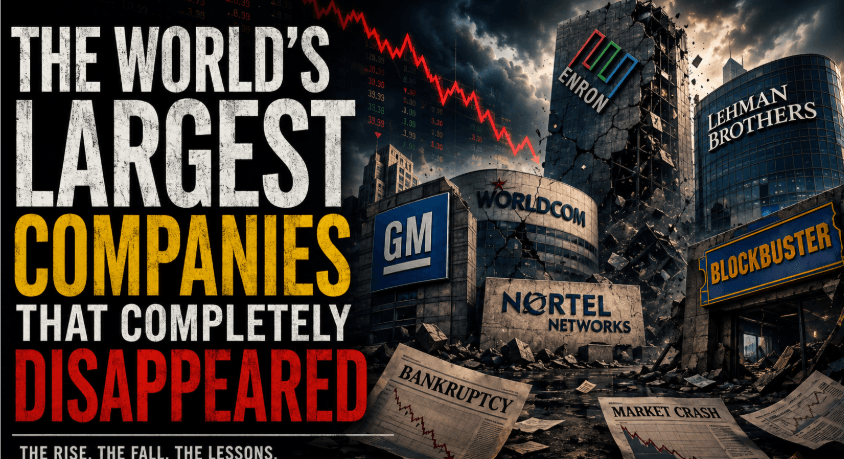
Go through enough lists of corporate collapses, and you start spotting a strange trend: the companies that fail are rarely the weak companies. They are the industry giants: companies that once employed tens of thousands of workers, controlled their markets, and seemed unbreakable.
For instance, Enron has always been a darling of Wall Street; Nortel had a higher market value than the four largest companies in Canada combined; General Motors was deemed the largest corporation in the USA for most of the 20th century.
And then in just a matter of hours, they were gone.
As opposed to just a corporate failure list, this is an attempt at understanding the very process of corporate deaths, because the same four patterns of failure keep repeating, regardless of the sector, decade, or geographical location. Once you know them, you are able to recognize the same pattern in the very corporations of modern days.
1. The Fraud Collapse: When the Numbers Were Never Real
Enron (peak value: ~$70 billion)
Enron’s downfall was not due to loss of profitability in trading. It went bankrupt because its financial records depicted non-existent profits. By concealing huge sums of debt using off-balance sheet entities, the executives showed inflated earnings for a long time. While annual revenue was shown as high as approximately $63 billion, its technique of forgery resulted in the biggest bankruptcy in the history of American business at that time and the collapse of one of the biggest auditing firms.
WorldCom (peak value: ~$180 billion)
One year later, WorldCom showed that Enron was not an isolated instance. The telecom behemoth, which came into being through a series of bold mergers, had about $3.8 billion in operating expenses as capital expenditures. CEO Bernie Ebbers was imprisoned in 2006 for what was then the largest fraud in the history of accounting. The lesson of both cases is the same: fraud does not go wrong through accidental detection, but because it demands unlimited growth.
2. The Leverage Collapse: When Debt Becomes the Business Model
Lehman Brothers (peak value: ~$60 billion)
Lehman Brothers was not selling substandard products. The company took a big gamble in the mortgage-backed securities market, which caused it to run out of capital when the housing market collapsed. Lehman sought emergency investment from several potential buyers and investors, but rescue efforts failed before it filed for bankruptcy on September 15, 2008. This act hurt the world’s financial systems.
General Motors (peak value: world’s largest automaker for decades)
GM’s bankruptcy was slow but structurally similar. Its burdensome worker commitments, widespread dealers, and strategic trend towards more gas-guzzling giants left the company with no avenues open during the 2008 financial crisis.
GM declared bankruptcy in June 2009, with total losses amounting to $78.7 billion, which also prompted the U.S. government to provide GM with a bailout of $49.5 billion to save jobs. Unlike Lehman, General Motors survived but only because it was deemed too structurally significant to the U.S. economy to disappear altogether.
3. The Disruption Collapse: When the Ground Shifts and Nobody Notices
Nortel Networks (peak value: $250 billion)
This might very well be the biggest collapse to be found in this ranking because Nortel does not fall under the category of a company guilty of fraud or excessive leverage, but simply failed to keep up. Nortel reached its peak market valuation of $250 billion and employed about 100,000 workers, offering technology solutions for both early internet and telecommunication networks.
The downfall happened because of the late way that Nortel reacted to changes in the mobile industry, and the company had already gone bankrupt by 2009. It goes without saying that a corporation with a market value of 250 billion dollars went bankrupt and then sold all of its assets.
Kodak and Blockbuster came to the same fate after several years: both companies understood that disruption was happening (Kodak invented digital cameras as early as 1975), but they didn’t realize that unless they changed their success, they wouldn’t turn the threats into profits.
4. The Slow Bleed: Death by a Thousand Structural Cuts
Sports Authority
Not every giant fails due to one spectacular downfall. Take Sports Authority, the largest sporting goods retailer in the USA, which closed down more than 450 stores after declaring bankruptcy in 2016 due to heavy debt, poor online management, and powerful competition from both box retailers and Amazon. There was no evil deed or terrible investment; the company simply stopped making money.
Tower Records tells a similar story. The chain had set up in-store listening stations for CDs and was among the first to offer online sales, but still had to declare bankruptcy two times as the industry went through fast transformations.
The Pattern Beneath the Pattern
| Company | Peak Value | Collapse | Main Cause |
|---|---|---|---|
| Enron | ~$70B | 2001 | Fraud |
| WorldCom | ~$180B | 2002 | Accounting fraud |
| Lehman Brothers | ~$60B | 2008 | Excessive leverage |
| General Motors | Largest automaker | 2009 | Debt and structural costs |
| Nortel | ~$250B | 2009 | Technological disruption |
| Sports Authority | Largest U.S. sporting goods retailer | 2016 | Structural decline |
When analyzing these catastrophes, one must notice a remarkable fact: it does not appear enough just not to be large to avoid collapse — today it looks like a company’s size has directly influenced the events. Availability of fraud is directly correlated with the amount of malice. Similarly, leverage must be mentioned along with confidence — the greater the company’s status on the market, the less the company is prone to be self-destructive.
None of the companies presented had problems with either financial or human resources; they just couldn’t hire people capable of pointing out the mistakes occurring in a company in time.
In fact, that is why only selected huge companies are surviving, while many more are disappearing. Thus, having access to enough money and workforce is not equal in importance to having a person able to understand that the present way of functioning of a company is wrong at that moment.