
The Underdog Nobody Believed In
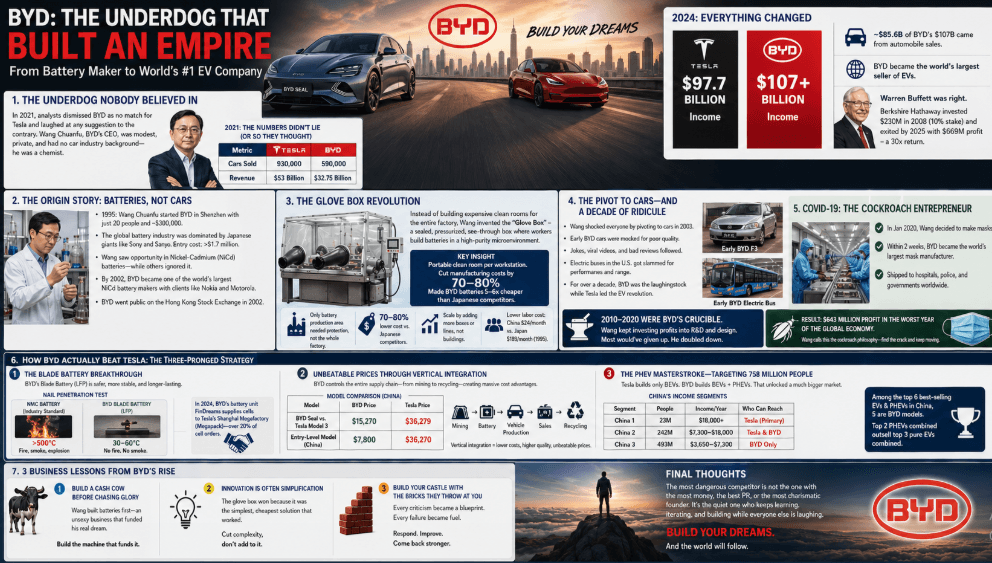
And the numbers seemed to confirm the mockery. In 2021:
Metric | Tesla | BYD |
Cars Sold | 930,000 | 590,000 |
Revenue | $53 Billion | $32.75 Billion |
Berkshire Hathaway purchased a small stake in BYD for $230 million in early 2008, representing around 10% of the company’s stock; it sold all its shares by the end of 2025, resulting in a total profit of $669 million at a 30x ROI. |
The Origin Story: Batteries, Not Cars
The Glove Box Revolution
Key Insight: Instead of cleaning the entire factory, BYD created a portable clean room per workstation. This reduced manufacturing costs by 70–80% — making BYD batteries 5–6x cheaper than Japanese competition. |
The results were extraordinary
- Just the section of the building that produces batteries had to have some type of protection placed over it; no other area required such a measure.
- The price to manufacture products with BYD dropped by as much as 70%–80% compared to what its Japanese competitors charged.
- To increase manufacturing output, BYD was able to add additional boxes and/or add additional lines with minimal investment rather than building new buildings.
- Labor rates were significantly less expensive. For example, in 1995, the minimum wage in China was approximately $24 per month compared to Japan’s at $189 per month.
The Pivot to Cars — and a Decade of Ridicule
The years 2010–2020 were BYD’s crucible. Wang kept pouring battery profits into R&D and design, refusing to quit. Most entrepreneurs would have pivoted. Wang doubled down. |
COVID-19: The Cockroach Entrepreneur
When the pandemic hit in 2020, global automakers hemorrhaged losses. Ford, Tata Motors, Jaguar Land Rover, and Nissan all reported devastating red figures. BYD had 224,000 employees it needed to pay with car sales frozen.
Wang’s response? He converted BYD’s car factories into mask factories. Within two weeks of making the decision on January 31, 2020, BYD became the world’s largest manufacturer of face masks, shipping to hospitals, law enforcement agencies, and governments globally.
The result: BYD made $643 million in profit in the worst year of the global economy. This is what Wang calls the cockroach philosophy — when everyone else runs for cover, find the crack and keep moving.
How BYD Actually Beat Tesla: The Three-Pronged Strategy
1. The Blade Battery Breakthrough
In 2020, BYD unveiled its Blade Battery — using lithium iron phosphate (LFP) chemistry instead of the nickel manganese cobalt (NMC) batteries used by Tesla. The difference was startling.
In the industry’s most brutal safety test — the nail penetration test — engineers drove a steel nail through a fully charged battery to trigger a short circuit. Standard NMC batteries caught fire at over 500°C. The BYD Blade Battery barely reached 30–60°C. No smoke. No fire.
🔋 In 2024, BYD’s battery unit FinDreams secured a supply deal with Tesla — not for Tesla’s electric cars, but for Tesla’s Shanghai energy storage Megafactory (Megapack product line). FinDreams captured over 20% of that factory’s cell orders, with Tesla’s motivation being cost reduction and supply chain diversification rather than any declaration of superiority. Still, the fact that a direct competitor is now buying your batteries speaks volumes. |
2. Unbeatable Price Points Through Vertical Integration
BYD controls its entire supply chain — from raw material mining to manufacturing, battery production, design, and recycling. This vertical integration delivers cost advantages that Western competitors cannot match:
Model | BYD Price | Tesla Price |
BYD Seal vs. Tesla Model 3 (China) | $15,270 | $36,279 |
Entry-Level Model (China) | $7,800 | $36,270 |
3. The PHEV Masterstroke — Targeting 758 Million People
Tesla builds only fully electric vehicles (BEVs). BYD also builds plug-in hybrids (PHEVs) — cars that switch to a petrol engine when the battery runs out. This single decision unlocked a market Tesla could never reach.
China’s population is broadly segmented by income:
In tier 2 and tier 3 Chinese cities with limited charging infrastructure, a PHEV was not just more affordable — it was the only practical option. Tesla could realistically target 265 million consumers. BYD could target 758 million.
📊 Among the top 6 best-selling EVs and PHEVs in China, 5 are BYD models. And the top 2 PHEVs combined outsell the top 3 pure EVs combined. |
3 Business Lessons from BYD’s Rise
Lesson 1:
Build a Cash Cow Before Chasing Glory
Wang didn’t start by building cars. He started by building batteries — an unglamorous, overlooked business that generated the cash flow needed to fund his real dream. Every rupee, dollar, or yuan BYD earned from batteries was reinvested into the automotive R&D that eventually beat Tesla.
Before you chase your dream, build the machine that funds it.
Lesson 2:
Innovation Is Often Simplification
BYD’s glove box didn’t win because it was high-tech. It won because it was the simplest, cheapest solution that actually worked. The most powerful innovations in business history are often the ones that cut complexity, not add to it.
Ask not: ‘How do I make this more sophisticated?’ Ask: ‘How do I make this simpler?’
Lesson 3:
Build your future with the pieces others tried to break you with.
For a decade, the world threw bricks at BYD — through mockery, bad press, failed products, and public ridicule. Wang picked up every brick and used it to build. The design critics? He hired world-class designers. The safety concerns? He invented the Blade Battery. The price gap? He mastered vertical integration.
Every criticism BYD received became a blueprint for what to fix next. That is the true secret of BYD’s rise — not genius, but relentless, systematic response to failure. |
Final Thoughts
The story of BYD is proof that the most dangerous competitor in any market is not the one with the most money, the best PR, or the most charismatic founder. It’s the quiet one who is learning, iterating, and building — brick by brick — while everyone else is too busy laughing.
Wang Chuanfu didn’t set out to defeat Elon Musk. He set out to Build Your Dreams. And somewhere along the way, the world’s greatest EV company was born.