History of PIA: The Rise and Fall of Pakistan’s Top Airline
The Beginning: From Orient Airways to National Carrier
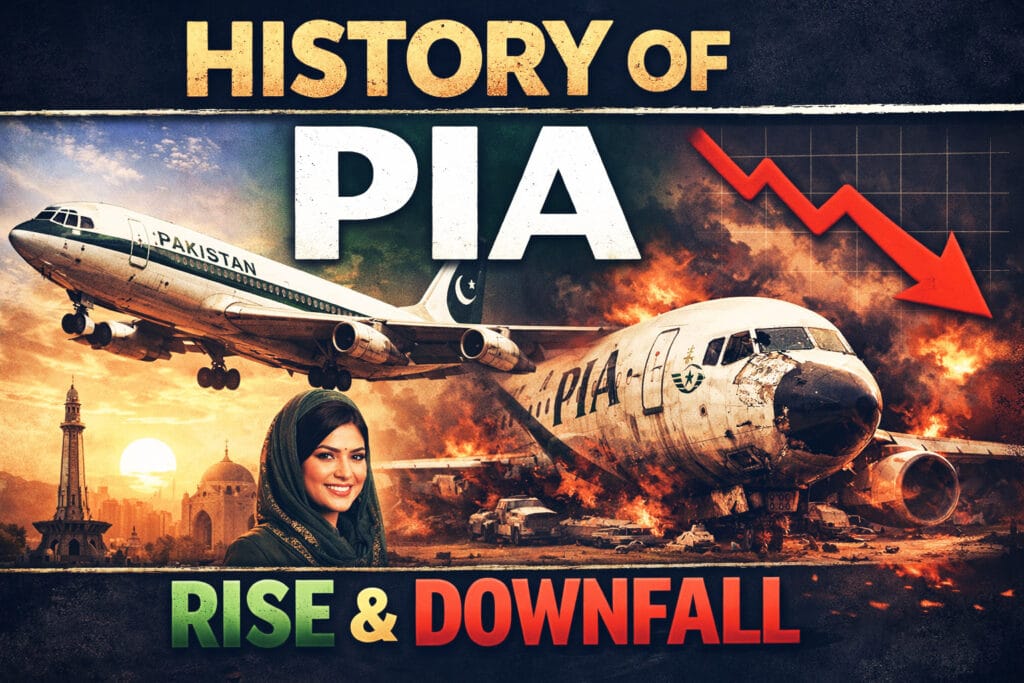
PIA actually started way before Pakistan came into being under the name of Orient Airways in 1946. It was the first airline that was owned by a Muslim leader. After partition, the Orient Airways operations were shifted to Pakistan. In 1955, it was renamed to Pakistan International Airways as the national carrier. In its very first year, PIA launched international flights, covering routes from Karachi to Cairo, Rome, and London.
Pakistan International Airlines Amazing Past
Pakistan International Airlines was the first Asian airline to use the Lockheed Super Constellation and the second to operate jet aircraft. PIA was the first airline to fly to China, despite being a non-communist airline. Even in Pakistan’s early economic problems, the airline progressed that much in just six minutes. PIA crafts were landing and taking off. In 1962, the USA’s first lady, Jacqueline Kennedy, visited Pakistan and chose PIA during her return journey. When the flight landed at London’s Heathrow Airport, she hugged the pilot and called out PIA’s slogan, “Great people to fly with.” Her repeated use of the slogan elevated PIA’s image worldwide.
In 1966, Saudi King Faisal visited Pakistan, and in 1967, Iran’s Shah Mohammad Reza Pahlavi also visited Pakistan along with his wife. After that, many top personalities visited Pakistan. With excellent decision-making, Pakistan International Airlines achieved significant profits and global recognition.
PIA hired the most groomed and well-mannered cabin crew; Momi Gul Durrani (air hostess) is still considered a notable figure in aviation history. PIA launched uniforms with national & cultural designs; later, India, Malaysia, Thailand, and Singapore Airlines followed the trend and introduced traditional uniforms. Pakistan became the first Asian airline to operate Boeing jets. PIA also introduced the first auto ticketing system.
Pakistan International Airlines launched connecting flights from Moscow to Europe. PIA was the first non-European airline to land in Norway. PIA also introduced the in-flight entertainment system in 1960. Karachi was an aviation hub. Many Western airline crew members visited Karachi for training from PIA’s training centers. PIA’s Managing Director, Irfan Ahmad, helped the airline make amazing progress with his experience.
Downfall of Pakistan International Airlines
Political Interference and Nationalization
In Chief Marshal Yahya Khan’s tenure, the downfall of PIA started. He appointed Zafar Chaudhary as PIA’s managing director, who, within a couple of months, fired half of PIA’s employees and sold many of its jets. This step was taken to help the economy after the 1971 India-Pakistan war, but after this step, PIA faced multiple challenges. In 1972, Prime Minister Zulfiqar Ali Bhutto took a major step by nationalizing PIA.
Pakistan International Airlines came under government control. When PIA’s headquarters were moved from Kolkata to Pakistan, it had multiple shareholders, including the government, but the private sector was also involved. After nationalization, jobs were given based on favoritism rather than merit. Politics began to influence the businesses. PIA was famous for its Boeing jets and routes, but no steps were taken toward fleet modernization.
Strategic Mistakes and Competitive Loss
PIA was already on the road to collapse, and then Zafar Chaudhary was again appointed as managing director. He took a step that caused major damage to PIA’s reputation: leasing PIA’s jets to Emirates. He gave two jets to Dubai’s ruler on a wet lease when Emirates was starting up. PIA provided Boeing 737-300 and Airbus A300B-200 aircraft, along with essential records, operational support, crew members, and engineering support. Dubai then overtook almost all PIA routes, including Mumbai, Delhi, Karachi, Amman, Colombo, Cairo, Dhaka, and Istanbul. People started choosing Emirates over PIA.
The airline was being run by corrupt people who took every step to bring the airline’s future to its lowest point. Management then decided to purchase more Boeing 747 aircraft. They couldn’t even manage. The jets were very modern and equipped with the latest technologies, but they were not in demand by passengers, which forced planes to take off with fewer passengers. This resulted in a significant loss on every flight.
The icing on the cake, these planes were purchased with a loan.
Financial Crisis and International Bans
In 2007, the European Union banned most PIA flights from entering Europe. The ban affected 35 of the airline’s fleet of T2 aircraft with seven Boeing 777s enameled. This ban caused serious damage to PIA’s reputation. Profitable routes were shut down over the years, including Washington (1996), Houston (2006), Chicago (2012), and New York (2017).
Profit and Loss: 2000–2023
From 2000 – 2023, Pakistan Airlines recorded profit only in 3 years (2002 to 2004). In 2005, PIA recorded 8,394 PKR loss per minute. In 2013, the losses increased to 80,000 per minute, and in 2023, they reached 234,465 PKR per minute.
PIA Flight 8303 Crash and License Scandal
In May 2020, PIA’s flight 8303 crashed near Karachi airport, killing 97 passengers. In initial reports, the plane crash was due to the pilot’s mistake. Within a month, Pakistan’s aviation minister, Ghulam Sarwar Khan, revealed in parliament that some pilots hold fake licenses. This scandal made international news, leading to a loss of reputation and a ban on international flights.
Privatization Attempts and IMF Pressure
In 2018, the government attempted to privatize several state-owned enterprises, including Pakistan Steel Mills and PIA, but the efforts failed due to political and financial challenges.
In 2025, Pakistan Airlines was privatized, ending government ownership. Pakistan Airlines was sold in 135 billion PKR to Arif Habib Corporation. The privatization was pressured by the IMF, as Pakistan is under an IMF program. international monetary fund asked the government of Pakistan for PIA by the end of the year. So the government made an offer for the attraction that involved separating the old liabilities into separate holdings.
Pakistan International Airlines had collected over $2.3B in long-term debt and liabilities, including bank loans, lease obligations, and pension liabilities. The government assured investors that aviation policies will remain stable, provide long-term operational freedom, and be free of political interference. Now, Pakistan International Airline is controlled by the private sector.
Conclusion
PIA’s journey reflects a dramatic shift from global aviation pioneer to financially distressed enterprise. Founded on strong leadership and an innovative concept, it once set an industry standard in Asia and built an international reputation. However, political interference, nationalization, mismanagement, overstaffing, departmental safety controversies, and growing competition ended its whole strength. Despite recent restructuring efforts, PIA’s future now hinges on whether genuine structural reform and professional management can reverse decades of decline and restore sustainable commercial viability.