China Automotive Industry and Its Rise to Global Dominance
As of 2023, approximately 29 million vehicles were manufactured by Japan, the USA, India, and South Korea collectively. China has consistently produced more than 30 million of its own cars. This raises a legitimate question — what caused such rapid growth? China has not historically occupied this space in the automotive industry. China did not begin developing its automotive sector until nearly thirty years after other developed nations, such as Germany, began doing so. However, today, China is the world’s largest car manufacturer and has also taken the lead in electric vehicles. BYD, Chery, and Changan are among the top leading car brands of China automotive industry.
This article will examine how three factors — strategic planning and decision-making, long-range visioning, and strategic policy development — have come together to propel China’s rapid rise to be the world’s largest manufacturer of cars and electric vehicles.
History of China’s Automotive Industry
Before the 1980s, China was known as the Kingdom of Bicycles. Bicycles dominated Chinese streets, but today, China is the world’s largest automobile manufacturer. Between 1920 and 1950, the USA led global automobile production, manufacturing about 75% of the world’s cars, while China’s production was nearly non-existent.
At that time, in the name of transportation, China had only manufactured trucks and some commercial vehicles; even everyone used cycles for transport purposes. 1/1000 people had a car. There were no passenger cars in China at that time.
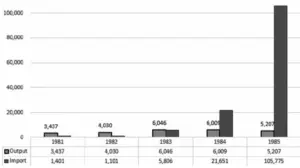
China did not have factories spread across the country. Their only option was to import, but there was a big problem even with that: a trade deficit. Simply put, China was spending almost all of its foreign reserves just to import cars. According to global auto production data, by 1985, they had spent $3 billion on importing passenger cars, even though their total foreign reserves were only $2.64 billion.
Their entire reserve is 1.3 times greater than what China has used for purchasing new vehicles alone.
As a result, the number of imports coming into the country has increased because of this huge deficit resulting from vehicle purchases; the Chinese government is concerned that, if this pattern continues, it will go bankrupt due to ongoing trade deficits.
How China Transformed Its Automotive Industry After 1980
In 1980, the Chinese government convened politicians, business leaders, and economists to discuss making the automotive industry a pillar of the economy to drive growth.
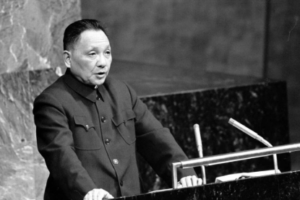
Deng Xiaoping argued that if China entered the automotive industry, it could establish its own global identity. China seized the opportunity because it had multiple reasons to select the automotive industry as a pillar.
As soon as Deng Xiaoping came to power, China opened its market to the world and designated the automotive industry as a pillar industry of the country. However, the question was: why make the automotive industry the pillar industry and not some other sector?
When discussions about new policies for the automotive sector were underway, China’s policymakers were divided into two groups: the ambitious group and the cautious group. The cautious group argued that “we should put the car industry on hold for some time.” According to them, the country still lacked the necessary infrastructure to support the automotive industry as a pillar sector.
Additionally, petrol supply in China was limited. Warning that an immediate elevation of the automobile industry as one of the pillars of industry could lead to increased air pollution, congestion on the highways, and depletion of resources. Thus, the cautious group proposed a moratorium on the development of the automobile industry and continued importing from other countries for now. In contrast, the ambitious group opposed this group.
The ambitious group said China must elevate its standing in the automotive industry to gain recognition as a global superpower in the future.
According to them, importing cars was wasting China’s foreign reserves and preventing domestic industrial growth.
An intense debate between these two groups over the automotive industry ensued. When analyzed through long-term industrial policy, in 1984, the Chinese government called an important meeting attended by top politicians, economists, businessmen, and scholars. After extensive discussions, the government finally declared the automotive industry a pillar industry of China in 1986.
Again, the question arises, why the automotive industry? The answer is Deng Xiaoping was a smart man. He found three reasons to select this industry as a pillar industry of China:
- Geopolitical Reasons
- The Car Industry as a Mother Industry
- Easy Accessibility
Geo-Political Reasons
In the era of the 1980s, almost every region had its global identity. Like the Middle East was the boss of the oil industry, India and Pakistan were known for their agricultural products, Japan and Europe had the upper hand in the electronic goods, whereas the United States and the Soviets were the giants of defense and aerospace.
But no country was producing automobiles as its main product, so China took this opportunity and now produces over 30 million cars annually.
The Car Industry as a Mother Industry
The car industry is not just an industry; it is a mother industry, meaning it forms an entire ecosystem. This is because the automotive sector drives the development of many related areas such as fuel stations, roads, service centers, infrastructure, and logistics hubs, creating abundant employment opportunities across the country.
When a car is manufactured, it uses a wide variety of materials and components, including engines, rubber, steel, wires, seats, textiles, and glass. This means that by promoting the car industry, a country also stimulates the growth of many other industries simultaneously. This was the second reason why the automotive industry should be made a pillar industry.

Easy Accessibility
China had a strong steel industry and also produced coal, aluminum, and rubber. This industrial growth was largely driven by China’s cheap labor and abundant land, which enabled extensive manufacturing and made it feasible to build a large-scale automotive sector.
At the same time, China also did not face any shortage of land, which made it very easy to set up factories anywhere. In other words, since almost everything necessary for the automotive industry was easily accessible, China had little reason to choose another sector as a pillar industry.
Power and Prestige
Apart from the three reasons mentioned earlier, there was another major reason that pushed China to make the automotive sector the main industry: power and prestige. Just as today, when a country manufactures fighter jets, the world perceives it differently. At that time, the global identity of countries like the USA, Japan, and Germany was largely associated with their car brands. Chinese leaders thought the same way: if China wanted to project itself as a modern and powerful country, it needed its own car brands. In this sense, the automotive industry was the ideal choice to enhance China’s global image.

Inviting Foreign Companies: A Strategic Move
In the late 1980’s, China pursued an aggressive development plan by encouraging foreign firms to establish formal manufacturing relationships with China. The advantage for foreign companies was access to Chinese labor, and Chinese companies would gain access to high-level technology from foreign firms through their investment in the Chinese economy.
Low-wage manufacturing in China also made it attractive to Western firms seeking new manufacturing sources in Asia. India had a favorable geography and a growing economy, but the regulatory environment, “license raj”(the bureaucratic permit system), made it very complicated and less attractive for foreign investors to establish operations there.
Learning from Foreign Expertise
China’s strategy wasn’t just about inviting foreign companies—it was about learning from them. A classic example is the 1984 joint venture with Volkswagen, called Shanghai Volkswagen Automotive Co. While Volkswagen assumed it was entering a cheap labor market, China’s real goal was to absorb the technology and production processes.
Through these joint ventures, China learned everything from engine design and safety systems to fuel efficiency and car body construction. By the 1990s, foreign companies like Volkswagen, GM, and Honda had a significant market presence, but China had already gained decades’ worth of expertise in just a few years.
Localization: Building a Domestic Supply Chain
China’s plans involved more than just inviting foreign businesses: they were to acquire knowledge from these foreign companies. The Shanghai Volkswagen Automotive Company joint venture, which began in 1984, is a very good example of this. In the minds of Volkswagen executives, this was going to be an opportunity for them to set up manufacturing facilities in a lower-cost labor market.
However, the primary objective behind having this joint venture in China was to take advantage of the technology and the production processes of VW. By establishing the joint ventures, China learned things such as how to design engines, develop safety systems, achieve fuel efficiency, and construct vehicle bodies.
By the mid-to-late 1990s, large numbers of foreign automakers (such as GM, VW, and Honda) had established themselves in the Chinese market, but the Chinese domestic automakers had gained access to technology and experience that would have taken them decades to acquire through legitimate means in less than a decade.
Joining the WTO: Unlocking Global Potential
2001 marked China’s entry into the World Trade Organization (WTO), which accelerated China’s rapid increase in its automotive industry. Foreign luxury auto manufacturers like Rolls-Royce, Mercedes, and BMW opening operations in China were important milestones for the development of the automotive industry in China. This completed China’s transition to become one of the world’s leading countries for automobile manufacturing, producing tens of millions of automobiles annually.
Shifting Focus to Electric Vehicles
Petrol still dominates in the global automotive industry, and China abandoned conventional petrol vehicles to focus on EVs. There were many reasons for China to do this:
- Energy Security – 75% of the oil that China uses is imported, and relying on transport for its energy is difficult to sustain.
- Control of Critical Materials – China produces nearly all of the lithium, cobalt, nickel, and other critical materials necessary for the production of EV batteries.
- Mass Production and Cost Reduction – Huge numbers of EVs being produced at one time allow China to reduce costs and produce EVs competitively around the globe.
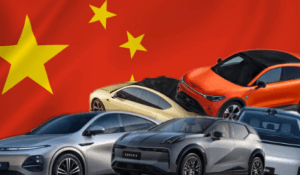
China has invested strategically, particularly in places such as Indonesia (nickel mines) and in the Lithium Triangle region of South America, to obtain resources, establish processing facilities, and dominate a large share of the global EV supply chain.
And recently, in January 2026, Reports suggest that China has made a trade deal with Canada. According to this deal, Canada will now allow up to 49,000 electric vehicles per year at a 6.1% tariff, down from 100%. It is a great deal for China’s car industry’s future. But these are unconfirmed reports.
Workforce Development: The Secret Ingredient
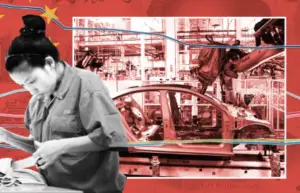
Recognizing that simply constructing factories was not sufficient alone, China also needed skilled labor for its automobile production. Thus, in addition to factories, it established technical colleges and polytechnical institutions that had a direct connection to the automotive sector by providing both theoretical and hands-on work experience.
This combination of education and practical experience resulted in a highly skilled workforce with increased income and greater demand for domestically manufactured automobiles, which consequently stimulated even greater growth in the automobile industry.
Lessons from China vs. India
On the other hand, India had a significant head start over China in terms of producing passenger cars and was a member of the WTO much earlier than China; however, India’s automobile industry was hampered by democratic politics, bureaucratic roadblocks, and too much emphasis being placed on theory. As a result, while China averaged 9.8% annual growth from 1993 to 2004, India averaged only 3.1%. In 2004, India manufactured 850,000 vehicles while China produced 5.7 million vehicles (7 times greater).
Conclusion: The Power of Long-Term Planning
China’s success in the automotive sector wasn’t accidental. It combined:
- Long-term government planning
- Strategic partnerships to acquire foreign technology
- Localization of production
- Workforce skill development
- Strategic investments in raw materials
- Policies promoting EV adoption and exports
China is the world leader in industry and trade, creating a complete ecosystem (from raw material through production and export) that guarantees its place at the forefront of global competitiveness. The lesson is clear: vision, strategic plans, and intelligent execution will elevate any country’s industrial capabilities.