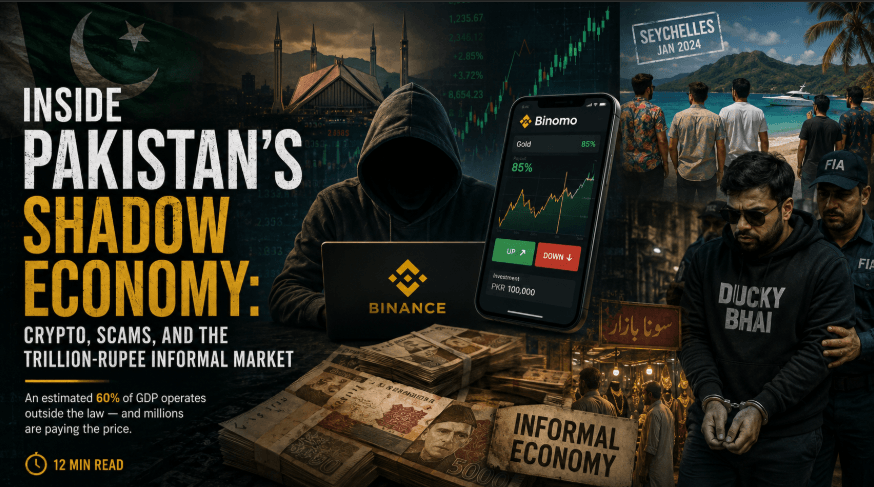
Inside Pakistan’s Shadow Economy: Crypto, Scams, and the Trillion-Rupee Informal Market
With an informal economy estimated at 60% of GDP, Pakistan has developed a vast financial system that operates entirely outside the law — and millions of citizens are paying the price.
12 min read
In January 2024, numerous top content creators from Pakistan and several other social media influencers travelled through the Indian Ocean Islands of Seychelles, which continue to be one of the most exclusive destinations for travellers in the world. A solo trip to the Seychelles can run between 7 and 10 lakh Pakistani Rupees. The influencers were hosted by Binance, which is the largest cryptocurrency exchange worldwide with regards to trading volume, and less than a year later, one of those influencers, Ducky Bhai (a YouTuber), was arrested for promoting illegal gambling/betting applications along with a binomio binary trading platform, which the Pakistan authorities claim to be illegal gambling and betting applications.
This contrast represents an essential component of the informal digital economy in Pakistan: it serves as an aspirational escape from a dysfunctional formal financial system yet it simultaneously functions as an exploitative snare, stripping ordinary Pakistani citizens of billions of rupees through deceptive schemes. In order to understand how the informal digital economy operates as well as why so many people are continuing to participate in it requires understanding the structural failures that exist in the formal financial system in Pakistan, which is what led people to participate in the informal financial system in the first place.
1. What Is an Informal Economy?
Every exchange between buyer and seller in a well-functioning, formal economy involves a third party (the state) that acts as a guarantor: ensuring that contracts are enforced; protecting property rights; providing legal recourse if agreements are breached; and providing public services with tax revenue.
If you remove this third-party (the state), you have what economists call an informal, grey, or shadow economy. This is where people conduct legitimate commercial transactions that are not conducted in accordance with any official, legal, or regulatory framework. All types of goods and services are exchanged without being recorded, taxed, or legally protected.
“The informal economy is not a marginal phenomenon in Pakistan — it is the dominant economic reality for a majority of its citizens.”
— Consensus view across multiple Pakistani policy research institutions
There are very serious practical implications. If you buy property without a proper registration (which happens often in the property market of Pakistan, as shown by recent scandals involving thousands of homes being built), you will have no legal recourse in case you end up in a dispute over ownership of the property. Also, if a cash transaction goes bad, you are at the mercy of the state — there’s no legal protection for you. Possibly most importantly, if your funds disappear due to a digital trading platform taking off with your money, there is no regulatory body for you to appeal to.
There are, of course, also costs with formal protections. The tax, compliance requirements, and bureaucratic processes required by states are what people pay for the state’s guarantee. The cost of that formal guarantee and the complexity of the system in Pakistan are causing millions of individuals and businesses to decide that operating outside of the formal system is a better value.
2. Who Operates Outside the System — and Why
There is a tendency to think that the informal economy in Pakistan is primarily made up of criminal elements (smugglers, drug dealers, or corrupt government officials who use bribes). While these are certainly part of the grey economy, they represent only a very small number of people.
Most of the people working in this area are not criminals but rather have to work in the informal economy due to the failure of the formal market system to meet their needs or for other practical reasons.
The Taxation Barrier
The tax structure of Pakistan is seen by experts as being unusually convoluted and inconsistently implemented. Often, the FBR has concentrated its enforcement efforts on people who already file returns and are compliant, while those who have never filed a return get away with very few tangible penalties for their failure to comply. For example, because of the compliance costs and potential tax liabilities resulting from formalization, small retailers/traders will often calculate that they would be better off if they did not become documented.
The Trust Deficit
A larger trust issue than that dictated by the economy exists within the institutions. When people do not trust that the government will follow through on their end of any bargain by enforcing contracts, protecting their property, or providing services for the taxes they pay, then the logical response is to minimize any involvement with formal institutions. The only way to resolve disputes using the law is to find a resolution through the courts.
The court system in Pakistan has so many outstanding cases that cases are often unresolved for decades after being placed on the docket. Trust in public institutions has been consistently low across international governance comparisons. Therefore, the informal economy is an extension of rational behavior rather than a departure from it.
3. The Scale of Pakistan’s Grey Economy
To measure an economy that was purposely set up not to be measured is inherently imprecise; however, estimates provided by Pakistani government bodies, the IMF, and independent research institutions provide a consensus view as to how troubling this situation is.
Key Figures:
~60% of GDP: Estimated size of Pakistan’s informal economy according to some official government analyses — though methodological differences produce estimates as low as 35% in other frameworks.
Real estate and retail are the two largest sectors of the undocumented economy, both characterized by predominantly cash-based transactions that are structurally difficult to audit.
Sub-Saharan Africa comparator: On comparative informality metrics, Pakistan’s grey economy as a share of GDP places it alongside some of the weakest institutional performers in Sub-Saharan Africa — regions where state fragility and endemic corruption are documented structural challenges.
$20–30 billion in estimated total cryptocurrency holdings by Pakistani citizens, despite crypto trading existing in a legal grey zone and Binance operating without State Bank of Pakistan authorization.
Gold markets in Pakistan provide an excellent example of large-scale informal trade. There are hundreds of this type of market all over the country, and they conduct billions of rupees in transactions each day. Many times, gold enters the marketplace via undocumented channels, similar to the networks that transport Iranian oil, contraband cigarettes, and smuggled electronics. The informal economy is much more than just a marginal phenomenon existing at the edges of Pakistani society; it is a parallel system, sometimes larger than the formal one, that operates alongside it.
4. The Digital Shift: From Cash to Crypto
For a long time, the informal economy had an inherent limitation, which was cash. Cash has an inherent limitation, which is that cash can be stolen, cash can be treated, and there are only so many people you’re able to have access to at one time.
In recent years, mobile devices, coupled with widespread access to the internet via those devices, have removed that limitation. Now, the informal economy resides in your phone.
Platforms like Binance offer Pakistani users a fully digital, largely pseudonymous financial infrastructure. An account can be created in minutes. Funds can be moved internationally without passing through the State Bank’s oversight mechanisms. For the approximately 17.5 million Pakistanis estimated to use the platform, Binance effectively functions as a parallel financial system: a place to store value, move money, and speculate on assets — entirely outside the formal banking sector.
The allure of cryptocurrency goes beyond its transactional nature. For many younger Pakistanis who have been integrated into the global internet culture, holding a wallet with cryptocurrency can be interpreted as having some form of social prestige.
This indicates that they are a part of a more current, fair, and borderless world of finance compared to the conventional banking system in Pakistan, which includes various aspects such as tedious documentation requirements, going to physical branches, and the overall untrustworthiness surrounding things like the Government’s association with conventional banks.
5. Binary Trading and the Anatomy of a Scam
Because of how easy it is to create an account on an unregulated digital financial platform, these types of platforms can be very risky. One can see this phenomenon on the large number of binary trading applications such as Binomo, which has received an overwhelming amount of promotion in Pakistan.
What Binary Trading Actually Is
Binary Options are being advertised more and more as an investment. An investment that people can participate in–to make money on the price fluctuations of an asset such as Gold, Cryptocurrencies, and Foreign Currency. However, in reality, it’s more like a structured bet than it is an investment. In Binary Options, a trader is betting on whether the price of a particular asset will rise or fall at a specific point in the future. If the trader is correct, he or she receives a fixed, predetermined payout; if the trader is incorrect, that trader will lose the entire value of the stake they placed on the trade. The underlying asset is not purchased, and there is no ownership or portfolio associated with the asset; the trader is not subject to normal market forces.
The European Union, the United Kingdom, and the United States have heavily restricted or banned Binary Options trading for retail clients. Regulators are citing that it is virtually impossible to trade Binary Options productively, and there are many examples of how traders have been manipulated by the trading platform. The Securities and Exchange Commission of Pakistan (SECP) has publicly stated that no Binary Option trading platforms have been approved for use in Pakistan.
The Influencer Pipeline
These types of platforms target Pakistani customers via a well-established process. Operators generally have registration in low oversight jurisdictions and use high social media accounts to find customers to engage in paid promotion agreements to promote an operator as a legitimate investment opportunity. Influencers offer the platform as a legitimate investment opportunity, frequently showing 80%-90% returns without disclosing compensation or verifying through independent means the regulatory status or the financial viability of the platform.
Feature
Binary Trading Apps (e.g. Binomo)
Regulated Platforms (e.g. PMEX)
SECP / SBP Authorization
None
Yes
Legal Recourse if Funds Lost
None
Available through SECP
Account Setup Time
Minutes
Days to weeks
Promised Returns
Up to 90% (unverifiable)
Market-rate (transparent)
Deposit Destination
Anonymous foreign accounts
Regulated local custodians
Withdrawal Reliability
Frequently delayed or blocked
Legally protected process
How the Trap Closes
These types of platforms are typically structured in a way that is consistent with the Ponzi scheme. The early investors can get small, real payouts, which provides the new investor with confidence, and they proceed with larger deposits. An additional incentive to continue investing is provided through referral bonus structures to encourage existing participants to bring in their friends and family, thus increasing the overall amount of capital to be invested. After a period of time, the participants will begin to experience delays in their request for withdrawals, have their requests blocked, and receive no response from customer support. The platform will become unavailable, and the participants will lose all of their money, as there will typically be no regulating agency with jurisdiction over any operators of the platform that is registered outside of the U.S.
One documented example of this is a Pakistani investor who sold his mother’s jewelry, which had a resale value of approximately $20,000, to invest in an internet-investing platform. There is no hope of recovering the loss through legal means. The Ducky Bhai prosecution demonstrates the sheer number of influencers involved in this ecosystem. Ducky Bhai did not act alone and was among a group of dozens of Pakistani content creators, collectively having tens of millions of followers, who promoted various apps or sites where they could not fully understand the implications of what they were promoting.
“Without realizing the risk, users wire their hard-earned money into obscure foreign accounts that exist entirely outside Pakistan’s financial oversight framework. Eventually, the system collapses entirely.”
— Pattern documented across multiple binary trading investigations in Pakistan, 2023–2025
6. Legal Alternatives Few Pakistanis Know About
The commodity and derivative trading infrastructure in Pakistan is regulated through the Pakistan Mercantile Exchange (PMEX), which was established under the oversight of the Securities and Exchange Commission of Pakistan (SECP). PMEX allows retail investors to lawfully trade commodities, including gold, silver, crude oil, and many others, all in a regulated, transparent transaction environment where buyers and sellers are both regulated by SECP, and where the investor community has access to legal recourse should issues arise out of commercial transactions.
The challenge for PMEX users continues to be awareness — and friction. The time and level of documentation required to open an account with PMEX is much greater compared with opening a binary trading account; thus that user population in Pakistan has anticipated instant gratification and has grown to distrust bureaucratic processes in general. Therefore, the time delay and greater level of required documentation to open an account with PMEX represent a significant adoption barrier.
Do Your Due Diligence on Any Financial Platform Before Making a Deposit into an Account
Confirm the platform is authorized by the State Bank of Pakistan (SBP) or SECP by accessing the listing on the SECP official register at secp.gov.pk
Verify that any broker provided by the financial platform is in possession of a current, valid license issued by SECP
Ensure that the financial platform is located in a country where it is regulated by an established financial licensing authority, such as FCA, SEC, BaFin, etc.
Be cautious when you are presented with a promised return on your investment that exceeds the prevailing market rate, because there are no legitimate investments that will consistently yield 80%-90%
Confirm that the withdrawal procedures are documented, transparent and verifiable by someone who is not affiliated with the financial platform
Search the platform name against SECP investor alerts and international regulatory blacklists before depositing any funds
7. Analysis: Why Enforcement Alone Cannot Solve This
With bans and restrictions on payments applied by Pakistani authorities to the expanding number of unregulated trade platforms, most of these measures only had a limited duration of benefit. When one platform is blocked, structurally identical substitutes will spring up, on average, within just a few weeks after the block. The primary reason that most users are accessing these platforms is not that they want to utilize any particular application, but rather due to the demand for low friction, democratized access to the financial system that the traditional sector is unable to provide.
This indicates that the government taking a purely enforcement approach is merely dealing with the symptoms of an issue instead of the actual cause. The more effective and long-lasting way to address this issue would be to reduce the overall cost and complexity of conducting business dehors — like simplifying tax registration, re-establishing institutional credibility, and providing true access to regulated financial products for the millions of Pakistanis who have already demonstrated their desire for access to participate digitally in the financial system through their previous use of Binance and similar platforms.
The Islamic financial tradition offers a relevant perspective here. Surah Al-Baqarah (2:282) — the Quran’s longest single verse — places substantial emphasis on the written documentation of financial transactions as a foundation of fairness, accountability, and mutual protection. The defining characteristic of Pakistan’s informal economy is precisely the systematic absence of such documentation. The moral and practical arguments against informality are, in this context, mutually reinforcing rather than in tension.
As you can see, even Warren Buffett, the greatest long-term investor in history, achieved most of his net worth after he turned 65. Creating wealth takes time, is well-documented, and uses compounding. The informal economy of rapid and easy returns is not a substitute for those things, but rather the majority of situations are the opposite — losses that are rapid or easy to accomplish with no institutional structure through which to recover losses.
The story about Pakistani social media influencers in Seychelles and getting handcuffed is more about systemic failure than the individual failure of the influencer. The informal economy — whether it is digital or otherwise- will continue to grow due to a lack of trustworthiness and lack of accessibility of Pakistan’s formal financial infrastructure.
Hammad Akbar is a political science student at the University of Balochistan and the founder of Brainification Blogs — a platform dedicated to the rigorous and accessible exploration of philosophy, world politics, and the shifting contours of global power.His writing draws from a commitment to intellectual honesty: situating ideas within their proper historical and theoretical contexts, interrogating assumptions that often go unexamined, and arriving at conclusions through reason rather than reflex. Whether engaging with the philosophy of the state, the dynamics of geopolitical rivalry, or the moral questions embedded in international affairs, Hammad approaches each subject as an invitation for genuine inquiry."Not just what to think about the world — but how, and why."
A contributor to academic journals and newspapers, he understands that credibility is earned not through assertion but through the quality of one's reasoning. His readers find in his work a rare combination: analytically precise arguments without being inaccessible, and perspectives that are firmly held without being closed.Hammad believes that in an era of noise and rapid-fire opinion, the most radical act is to slow down, think carefully, and write with clarity and care.