
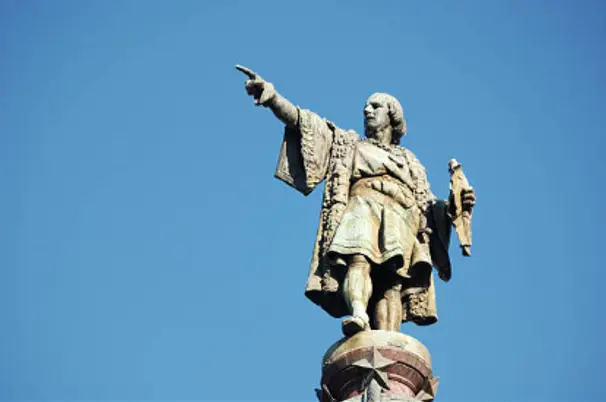
Did Christopher Columbus Really Discover America?
The belief that Christopher Columbus was the first to discover America continues to pervade our culture even today. Textbooks, movies, and television, as well as popular conversations, are all very saturated with this belief. However, most historians have arrived at a consensus supporting the claim that it is not true; this is because Columbus had no such involvement, nor was he the first to set foot on what is now referred to as “America.”
Why then do people in general associate Columbus with the “discovery” of America?
The answer lies in understanding a historical context for “discovery.”
What Does “Discovery” Mean?
Historically, when people refer to the term ‘discovery’ regarding an explorer such as Christopher Columbus or Vasco Da Gama, they use this term when referring to a specific geographic place. Exploring alone does not define their ‘discovery,’ as many regions already had established cultures before European exploration. For example, India had an advanced civilization before Vasco da Gama arrived in 1498. The country was also home to many native communities across different regions. Similarly, millions of Native Americans lived across the continent of North America before the arrival of European explorers such as Columbus. Therefore, when historians say that Columbus discovered the Americas, they are using the term ‘discovered’ to mean that Columbus was the first European to report back to Europe about this area of land that was previously unknown to anyone on that continent.
America Before Columbus
Europe in the 15th Century: Fear of the Unknown
Need for New Trade Routes
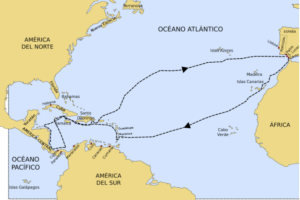
There were approximately a thousand years during which European countries could only obtain goods (spices, silk, etc.) through overland trade routes. These trade routes connected Europe with Asia through the central power of the Byzantine Empire. A series of wars fought between the Byzantine Empire and the Turks caused the loss of all overland routes for Europeans to enter Asia, and many believed that the number of overland routes to the Asian continent had been significantly reduced due to these wars. As a result of this increased need to access Asian markets, new methods of entering the Asian continent were required, which led to the creation of maritime trading routes connecting Europe with Asia.
Two Possible Routes to Asia
Europe had two different choices:
- Sail around Africa
- Sail west across the Atlantic Ocean
The first option was already used by the Portuguese explorer Vasco da Gama when he sailed around the Cape of Good Hope and made it to India. However, the second option was much more dangerous and uncertain. This is where Christopher Columbus becomes involved in history.
Who Was Christopher Columbus?
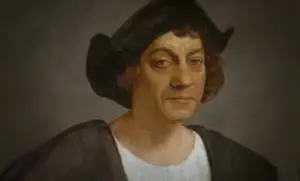
Christopher Columbus was born in 1451 in the city of Genoa, Italy, in an ordinary, middle-class family, and his parentage can be traced to a merchant family. There is very little historical evidence that provides any detail about Columbus’s family background. What made Columbus exceptional was that he had a unique ability to persuade influential people to partner with him financially. Columbus had a passion for navigation, astronomy, and geography.
Columbus believed that the Earth was round in shape and that if he sailed west, that would be a quicker way of reaching Asia than sailing eastward. He did not know that there was an entire continent between Europe and Asia. His first contact as a sponsor for an expedition was the King of Portugal, who turned him down, and then he travelled to Spain. He went through several funding issues and was even homeless for a period while living in the Monastery of La Rabida. However, he met a monk who was well-connected to King Ferdinand and Queen Isabella, which helped him gain the support he needed. After years of being rejected, delayed, and distracted by political events, Columbus was finally able to convince the Spanish government to support his expedition on August 17, 1492.
The First Voyage (1492)
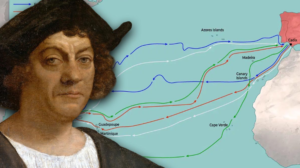
On the 3rd of August, 1492, Christopher Columbus departed from Spain with three ships:
- Santa María
- Pinta
- Niña
The expedition included a diverse group of sailors, soldiers, religious figures, and men who had been convicted of crimes, who were granted amnesty on the condition that they participate. As
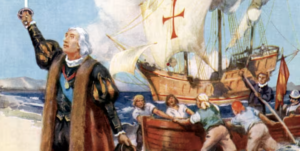
Weeks passed, and the sailors continued to sail without any sign of land. Mutiny was becoming a real danger. Columbus made the following promise to his sailors on the 9th of October, 1492: “If we don’t find land within three days, we will turn back to Spain.” Later, on the evening of the 11th of October, 1492, while sailing through the darkness, one of the crew members reported that they saw a light over the horizon. By the time the sun rose on the morning of the 12th, the crew finally had visual confirmation of land. On the 12th of October, 1492, Columbus arrived on an island located in the present-day Bahamas, believed to be San Salvador Island. Columbus mistakenly thought he had arrived in the East Indies and therefore named the indigenous population “Indios,” a term that would later evolve into “Indians.”
First Contact with Native Americans
Christopher Columbus wrote in his personal diary about the appearance and features of the Native Americans. He noted that there were scars on their bodies; they could easily be enslaved. He suggested that they had no religion to worship and would convert to the Christian religion. Also, he considered them weak, as he noticed that they lacked metal weapons.
The Beginning of Colonization
Columbus sailed on four journeys to the New World. After Columbus’s second voyage, his returning fleet consisted of
- 17 ships
- approximately 1,500 crew members
Thus, he was now engaged in colonization rather than exploration. Indigenous peoples were subjected to the following abuses:
- Slavery
- Torture
- Deathly violence
- Forced labor
Within many years of the time when European contact began with Native peoples, several Native communities had been totally wiped out.
Columbus: Explorer or Oppressor?
Christopher Columbus remains one of the most controversial historical figures in history. There were different perspectives about him. Some people think that he was a brave explorer and a symbol of courage and curiosity, while some think that he was an oppressor who promoted colonization, exploitation of resources, and genocide.
Interesting article , impressive research,👍🏻
👍