
The Three Metamorphoses of Spirit: What I Learned from Them
From childhood to adulthood, we all grow with the belief that the goal of our lives is stability. Our thinking naturally works this way; we set goals to get a safe job by avoiding unnecessary risks and arguing. And to be honest, for a long period of time, I also thought the same.
The reason is that when the person argues too much and asks questions, the world labels them the tag of “difficult.”
But at some point in life, something starts to feel… off.
You have it all right, but you also feel frustrated in some way that you will not be getting clear. You begin to realize that the worse off you get, the less alive you are. It is then that I first encountered the works of Friedrich Nietzsche – and, to be more precise, his concept of the Three Metamorphoses of the Spirit from his book ‘Thus Spoke Zarathustra’.
He had a strange but powerful idea:
A human being is not an endpoint — but a bridge.
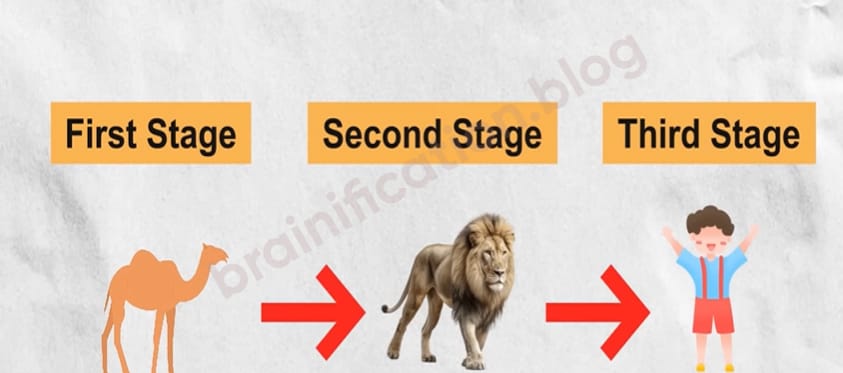
Friedrich Nietzsche explained the evolution of the spirit in three psychological stages. Below are the three metamorphoses of Nietzsche:
- The first one is The Camel.
- The second one is The Lion.
- And the last one is The Child.
We will explain to our readers the psychological stages of Spirit evolution in this blog. These are three stages of personal growth that help me a lot in my life, and I want you to read and experience important life lessons by the great Friedrich Nietzsche.
1. The Camel (Stage one)

The first stage of the three metamorphoses is the Camel. In the Camel stage, you face responsibilities and tough challenges, much like a camel in the desert.
For quite a while, I did not realize that I was living under this belief. This is similar to many people; many people go along with what society says you should do by getting a good job with no risk, and don’t question who has authority or any societal norm. In fact, I spent more time doing what was reasonably expected of me but less time determining and understanding my likes, desires, and abilities.
Camels face challenges in the desert and carry a burden of goods on their backs, walking for days until they reach their final destination. Nietzsche chose the camel as a first stage of evolution and teaches its readers to learn to carry their own burden. In life, no one will help you, and you must carry it on your own.
This stage of metamorphoses tells you to be humble and admit the reality that you are not perfect, not just you, but no one on Earth is 100% perfect, even if we take today’s modern example, even Artificial Intelligence makes mistakes. Rockets that were built by genius scientists sometimes fail. Humans make mistakes; the question is, does he accept his mistake with pride?
The camel stage is not just about being patient and disciplined, or doing hard work without attracting others’ notice; instead, the camel stage helps us learn to face difficulties and carry the burdens of life with pride, even when we feel uncomfortable while trying.
“Three metamorphoses of the spirit I designate to you: how the spirit becomes a camel, the camel a lion, and the lion at last a child. …The camel loads itself with heavy weights, and loves the heat of the desert; and that which is hardest, most unsparing, most heavy, it bears gladly upon its back and says, ‘What is heavy? That is my love!”
— Friedrich Nietzsche, Thus Spoke Zarathustra, Part I, “The Three Metamorphoses” (trans. Walter Kaufmann, 1966)
— Friedrich Nietzsche, Thus Spoke Zarathustra, Part I, “The Three Metamorphoses” (trans. Walter Kaufmann, 1966)
In contrast,
You take responsibility for your:
- habits
- decisions
- fears
- insecurities
- past mistakes
The Lion (Stage two)

As you know, a lion is a metaphor of bravery.
The Lion stage for me began after I realized I could not live my true life the way the world defined success. I found myself psychologically imprisoned because I was living my life by the expectations of others. I began to be challenged on what I wanted and I would have to make some very difficult decisions and say “No” to things that were not in line with what was actually of interest to me, even if it meant that people would be critical of me for not taking that path or if I would have to deal with uncertainty in my decision making.
Nietzsche says that the second stage comes in between the first stage metamorphoses of spirit, when the camel is running in the desert with a burden on its back. The second stage is not the destruction of the first but the sublimation, which means a gradual internal change.
This is the stage where humans become like lions, ready to fight the dragon. Nietzsche uses the example of a dragon as a metaphor for inherited moral values and societal duties.
In the second stage of metamorphoses, you will get a lesson in fighting back against imposed values. Unlike in the camel stage, you were learning to burden yourself and to suffer. It is not the stage (the lion) where he creates new values, but prepares himself for the future creation of values like the concept of ‘re-evaluation of all morals’, meaning that whatever moral lessons are given to you must first be tested, no matter whether it is an ideology or anything else.
Nietzsche says human beings achieve the bravery to reject old values at this stage because they take the first step towards freedom and learns to say ‘No’.
In psychology, this is similar to assertiveness training: when a person does not know how to say no, they suffer in their life.
“To create freedom for oneself and a sacred No even to duty: for that, my brothers, the lion is needed.” (Friedrich Nietzsche, Thus Spoke Zarathustra, Part I: The Three Metamorphoses.)
Let me explain the lion stage with a real-life example: a student wants to be an independent person, but society pressures him to become an engineer to secure his career. But he stands against society, says no to it, and challenges its values for his better future.
In contrast, one major difference between a slave and a free individual is the ability to say no, meaning a person does not know how to refuse things they are not naturally willing to do.
The lion stage helps you to learn to say no. This is the stage where you become capable of preparing to place a new order and to develop your own values.
Stage 3: The Child (Third Stage)

After carrying your own burdens (camel) and learns to say no (lion), there will be another stage, the third stage of metamorphoses known as the child. In the child stage of metamorphosis, a person’s spirit reaches a phase capable of creation. Nietzsche chooses the name child for the third stage because the child is known for his innocence, the art of forgetting, and represents a new beginning.
Unlike the lion stage, in which a person rejects imposed values and breaks inherited moral duties. The child moves on beyond resistance and begins to construct its own meaning of life. The third stage symbolizes the ability to say Yes to life after learning to say No in the previous stage of the spirit’s metamorphoses.
In regard to my own journey through stages, my experience developing and working on Brainification was a good example of moving into this phase, as I moved from being constrained by others’ expectations and predefined career tracks to defining my own path guided by my passions, interests, and personal principles. I transitioned from simply saying “no” to the status or any external pressures to actually creating my vision of success.
Nietzsche says:
“The child embodies innocence and the art of forgetting, a fresh beginning, a playful spirit, a self-moving wheel, a first step, a sacred Yes.”( Thus Spoke Zarathustra, Part one: The Three Metamorphoses.)
In contrast, a person learns the actual meaning of life in the third stage and becomes self-directing and creative. The child can no longer carry the burdens of the past and has become free from imposed values. Instead of opposing the existing norms, the spirit can create its own values.
If we understand this psychologically, this stage is about creativity, autonomy, and the formation of a new, personal, independent identity.
What do we learn from The Three Metamorphoses? How does it help us in personal growth?
The three metamorphoses of spirit described in Thus Spoke Zarathustra by Friedrich Nietzsche teach us that personal growth is a gradual inner transformation that moves in three steps: from obedience to independence, and then to creativity. With the camel stage, we learn to develop discipline and a sense of responsibility.
The lion will give us the courage to question and say No by rejecting imposed societal values, and in the final stage, the child creates their own meanings by saying Yes to life.
These three stages of spirit can provide us with a psychological roadmap for self-development by shaping an authentic identity based on self-created values.