
When I first encountered Bertrand Russell’s In Praise of Idleness, it felt less like philosophy and more like a challenge to everything we are taught about success. Living in a culture where constant work is praised and rest is seen as weakness, Russell’s ideas forced me to rethink why being “busy” is treated as a moral achievement.
About Bertrand Russell
Bertrand Russell (1872–1970) was a great British philosopher, mathematician, and logician of the 20th century. He was a popular writer of his time and wrote many masterpieces like A History of Western Philosophy (1945), Principia Mathematica (1910–1913), In Praise of Idleness, and dozens of other books.
Russell also wrote more than 2000 articles, essays, and social commentaries. Some of his revolutionary essays include A Free Man’s Worship (1903) and Sceptical Essays (1928).
Beyond philosophy, Russell also examined and criticized war, authoritarianism, and obedience to systems of power. He was a great writer, and for his literary work, he was awarded the Nobel Prize in Literature in 1950.
Bertrand Russell’s influence comes from his ability to connect his abstract ideas to real human suffering, freedom, and creativity.
In Praise of Idleness: How Bertrand Russell Exposed the Biggest Lie of Hustle Culture
You know what the biggest lie ever told us is to this day? That working is the greatest job. I am not telling you this; this is said by the greatest philosopher of the 20th century, Bertrand Russell, in his path-breaking 1935, revolutionary essay In Praise of Idleness.
Since childhood, we have been told that working is great and being idle and free is a sin. But what if I tell you that this lie is just told to tire you out, nothing else.
In today’s hustle culture, the most respected thing is to work all the time and be busy. If you work all night, stay busy, or tell everyone you are very busy, society will think you are successful.
But if someone asks you a question about what you do, and your answer is “I am free or idle,” then he thinks you are actually free. He will start forming a negative image of you because, in today’s capitalist world, work and busyness are everything.
The great Bertrand Russell challenged this question in a way that no one ever had done before by writing his revolutionary essay In Praise of Idleness.
In this essay, he wrote something that society never expects. By the time this blog is finished, your perspectives on hard work will have changed.
What Is Work According to Bertrand Russell?
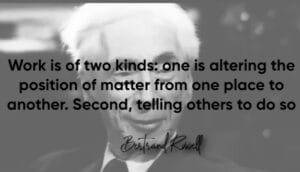
Before we talk about work, we must first understand what work is, and Bertrand Russell gives an outstanding definition. According to Bertrand Russell, there are two kinds of work: work is moving matter from one place to another. He calls it manual labour. The second type of work is when you instruct someone else to move matter from one place to another.
In both cases, work is moving matter, whether you move it or you instruct someone else to move it. If you look at any service or business in the world, they are all fundamentally doing the same thing: moving matter.
Russell says the second type of work, where you instruct others to work, has no limits; this can carry on forever.
A supervisor above a labourer, another monitoring lead above the supervisor, a deputy manager above the monitoring lead, a manager above the deputy manager, a senior manager above the manager, and the list goes on.
How Work Created Classes and Power Structures
Russell used to say that the first kind of work, where a person has to do manual labour, is unpleasant and badly paid, while the other kind, where you instruct, is pleasant and better paid.
But the real struggle begins here, due to these two kinds of work, two classes are formed in society:
Working Class
Middle Class
The working class performs manual labour, and the middle class supervises it.
The story does not end here; there is still one more class to add: the third class, “the landowners”. This is the class that runs both the working and the middle classes.
The whole story revolves around this class. Look at history and see when the owners of society were chiefs and landlords. They didn’t do the work themselves. Instead, they hire people to work for them. They used to stay idle all day and tell others to work hard.
The whole morality and ethics surrounding hard work — isn’t it a blessing in hard work itself? Work hard, and only those who work will come out ahead.
We think this is given to us by religion or society, but the deep, dark secret is that landowners and chiefs taught us to work harder, so that they could enjoy freedom and leisure themselves.
These landowners have always taught the workers and the general public that work is worship. The harder you work, the more blessings you will receive in your earnings.
They have made the entire society work hard, telling people to work 10 or 18 hours, and discouraged independent thinking by turning work into a moral duty.
People like Elon Musk claim to work 100 hours a week. In reality, they work because they have the most at stake in that business. When a business becomes truly successful, the most wealth comes to them (the capitalists).
The workers who work for a few dollars, why do these capitalists want them to work 16 hours a day?
These capitalists and landowners make this hustle culture look beautiful for their own benefit.

Why the Belief That Work Is Virtuous Is Dangerous
This is the fundamental problem that Bertrand Russell wants to explain to us.
This ruling class made work a moral obligation for the working class. Russell said that after the invention of machines, humans should have become freer, because one machine can work more than 1000 humans at once, yet machines increased the workload on humans. The real danger arises when work itself is treated as a moral virtue.
Bertrand Russell argued that believing work is inherently virtuous causes deep harm to society.
It means that a society suffers the most when it believes that work is the only good thing.
We understood Russell’s point, but we also have to counter Russell with the question that arises: if we do not work, then how will the economy work?
Russell gives a revolutionary answer; if the world applies it, the entire world will change. Russell changed the definition of work with his outstanding philosophy, saying: Change your perspective on work; do only the amount that satisfies you and gives you a fulfilling life.
The Four-Hour Workday and the True Purpose of Life
When humanity starts thinking like this, it will reach the conclusion that the less work a person does, the happier they are.
To back his claim, he recommends that we all work only 4 hours a day.
He says that our system is designed in such a way that those who are working are overworked and those who are not are unemployed. If we all work 4 hours a day, then the work will be divided among the entire population. Like this, everyone will be employed, and all of us will have leisure time for other creative activities.
The best thing in Bertrand Russell’s essay In Praise of Idleness is that when we work only 4 hours a day, we can spend the rest of our time on creative projects. The purpose of life is not just to move matter; rather, the main purpose of life is to have a creative interest in it.
Man does something creative: pursue science, learn and understand philosophy, or do some artwork.
What Bertrand Russell called the “morality of slaves” is a system that rewards obedience over freedom. The world doesn’t need slavery. The landlords want to make people slaves. If you work all the time, your life will pass you by. Being free also has its own pleasures.
Great works have not been done by tired workers, but by free people who are always thinking.

Conclusion
If a man only works, he forgets the art of thinking and becomes part of the system. When you become part of the system, you can’t work outside it; it will kill your creativity, and you’ll never do anything big.
Idleness doesn’t mean being tired; it means thinking without any pressure and learning more out of love of learning.
According to Bertrand Russell, life isn’t just about working hard; its actual meaning is living for yourself. Perhaps the greatest rebellion is not that you start speaking against the system, but rather that you take time for yourself when you are free.
Russell’s words may seem utopian and idealistic, but the reality is that a person rarely does creative work under pressure.
In the last 2000 years of human history, whose name has survived: Socrates, Plato, Friedrich Nietzsche , Sigmund Freud or Napoleon? Take up the field of arts or literature; only those people succeed who become the boss of their own time during such idle moments.