Mahatma Gandhi: A Great Leader, a Flawed Human, and a Complicated Legacy
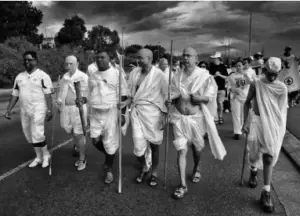
An image instantly springs to mind when Mahatma Gandhi’s name is mentioned, that of an ordinary individual, dressed in white, holding a stick and walking about preaching non-violence and truth.
In India, he is known as the Father of the Nation, and to the world, he is known as one who managed to bring down the British Empire without the use of arms.
Some interesting truths emerge from a close examination of Mahatma Gandhi’s place in history.
This article does not intend to “cancel” Gandhi, disrespect the history of India, or his tremendous impact in ending British rule; instead, it seeks to do something much more honest: to view Mahatma Gandhi as a real human being, not simply a saint carved in stone. As with any great leader in history, Gandhi had his share of contradictions.
The Making of Gandhi: From Privilege to Protest
Born in 1869 Porbandar, Gujarat, Mohandas Karamchand Gandhi learned about self-control, modesty, vegetarianism, and moral discipline from his mother — a quality that would later define him as a public figure — and his father, who was a chief minister.
While attending school in London, he had his first exposure to modern industrial society and was shocked by the disparity in wealth distribution alongside extreme poverty.
Additionally, he was horrified by the amount of human suffering he saw hidden behind the pride of colonialism; each of these events caused him to question modern civilization and eventually characterize it as a “disease.”
The event that ultimately transformed Mahatma Gandhi into an activist unable to tolerate injustice occurred in South Africa.
He was subjected to extreme racism on multiple occasions, thrown off a train, beaten, and denied entry into a hotel because of his race, and this occurred despite his education (in fact, he was a lawyer).
The events that transpired during his time in South Africa sparked within Gandhi the belief that all injustice should be fought against — but through peaceful means.
This is the Gandhi most people know: the man who stood up to oppression using non-violence, civil disobedience, and moral courage.
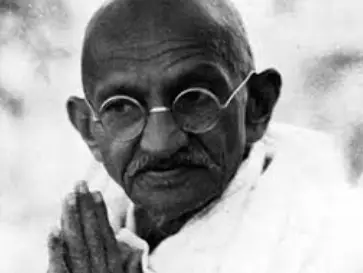
Mahatma Gandhi
Gandhi and Race: A Troubling South African Chapter
Mahatma Gandhi opposed discrimination against Indian people, but showed very strong racial prejudices against black African people in South Africa in earlier years. As seen in the documents of Gandhi’s writings in the Indian Opinion and his own notes, Gandhi said that black Africans (or “kaffirs” — now recognized as a derogatory term) were an inferior group compared to Indians and he believed they were less “civilized” than Indians; therefore, it was not acceptable for Indians and black Africans to be treated equally as public citizens. As proof, he petitioned for laws to make black Africans and Indians stand in separate lines while waiting for public transportation.
Historians such as Ashwin Desai believe that Gandhi’s opinions on the racial structure in South African society showed that Indians were superior to black Africans and so he did not try to fight racial inequalities, while B.R. Nanda and E. S. Reddy see Gandhi’s perspective toward black Africans in South Africa as part of a political learning process where he would eventually understand the effects of colonial oppression on the people of South Africa.
These issues about the perceived level of racial equality, and whether Gandhi’s opinions about black Africans in South Africa were a product of the times he lived in or a deliberate belief in racial superiority, are still debated today. Regardless of a historian’s conclusion about Gandhi’s racial views, it is clear that many people today still struggle with the fact that Gandhi could think in a racial way.
In 2016, students at the University of Ghana took down Gandhi’s statue from their campus and asked the question:
“Why honor a racist?”
University of Ghana, Mahatma Karamchand Gandhi’s Statue Toppled
The Celibacy Experiments: Faith or Moral Blindness?
Gandhi’s most controversial scandal is probably his sexual experimentation (brahmacharya or celibacy).
At the age of thirty-eight, Gandhi took a vow of celibacy, believing that sexual desire would prevent him from achieving spiritual purity. To test his self-control, he began sleeping in the same bed with young women—including his grandniece Manu Gandhi—while saying he would not touch their bodies.
This is well documented in his letters and diaries.
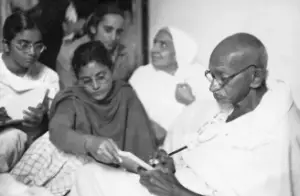
Mahatma Gandhi with Manu Gandhi
He argued that this was all about discipline and not desire; however, this behavior has made many people feel uncomfortable and was considered ethically wrong, even though he intended to practice self-discipline by sleeping with these women. Many believe this was manipulative or an abuse of power.
This controversy keeps resurfacing, as there have been protests to have him removed from some statues in California.
Women, Marriage, and Control
Gandhi had a complicated and sometimes problematic relationship with women, which can be seen throughout his life.
For instance, when Gandhi rejected modern medical treatments for his wife, Kasturba Gandhi, in favor of spiritual healing, many have cited this as one of the most significant failures of his life. After all, Kasturba died in Agha Khan Palace in Poona because of this choice he made.
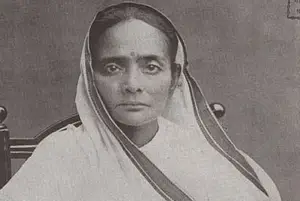
Wife of Mahatma Kasturba Gandhi
In addition to the treatment of his wife previously mentioned, Gandhi held conservative views toward women throughout his life. He believed that women were responsible for acts of sexual violence; told women who had been assaulted to shave their heads so men would not take notice of them; and determined that menstruation was an indication of a woman’s moral decay.
Although he had some messages of liberation for women, as they did come with a price, many of his statements regarding women parallel sexism today.
Caste and the Clash with Ambedkar
Upon returning from abroad, Gandhi started the Harijan Movement and referred to Dalits as “Children of God.” Although it is believed that his approach merely softened, rather than abolished, the brutality of the caste system.
Dr. B. R. Ambedkar, an Untouchable and civil rights advocate, completely rejected Gandhi’s and the Congress Party’s view on Dalits. According to Dr. Ambedkar, Dalits do not require sympathy or new forms of identification, but need rights, respect, and structure. His book, What Gandhi and Congress Have Done to the Untouchables, criticizes Gandhi for maintaining rather than destroying the hierarchy of caste.
Gandhi believed the caste (varna) system was a natural part of Hindu society and acceptable as long as it existed without violence—a view that Dalit intellectuals strongly opposed.
Moral Politics: Strength or Weakness?
Ramachandra Guha (historian) suggests that Gandhi’s legacy is the use of morality as a form of political action; thus changing political struggle from the pursuit of power to ethics.
However, Gandhi’s moral absolutism also posed difficulties.
For example, Gandhi wanted followers to fast, vow, and live with rigid self-discipline while participating in politics, but politicians like Subhas Chandra Bose, Ambedkar, and possibly Bhagat Singh disagreed, arguing that politics relied on prudence, strategy, and force.
Gandhi’s comments during World War II, suggesting that Jews remain non-violent toward the Nazis, are often cited as an example of how his pursuit of moral purity sometimes clashed with reality
So, How Should We Remember Mahatma Gandhi?
Mahatma Gandhi undeniably changed the world. He inspired figures like Martin Luther King Jr. and Nelson Mandela, turning non-violence into a global political tool. India’s independence would look very different without him.
But he was also deeply flawed.
He held racist views in his early years. He justified caste hierarchy. He made questionable decisions in his personal life. He often imposed his moral standards on others.
As Ramachandra Guha wisely puts it:
“Gandhi’s greatness lies not in his perfection, but in his constant struggle with imperfection.”
The Bigger Question
Are historical figures judgedbasedsolelyon their accomplishments, or dowealsoassessthetotalityoftheirexistence? Isitfairtoimposecurrentsocietal standards onto people wholivedmanyyearsago?Canwe admire Mahatma Gandhi forthe contributions hemadewhilealsorecognizing the faultshehad?Areasonableresponse is that Gandhi isnotanunblemishedangel nor anevilperson;rather,heis a verycomplicated human being. ThebiggestlessonthatcanbelearnedfromGandhiis that great moral leaders are still humans,andassuch,areimperfect.
Hammad Akbar is a political science student at the University of Balochistan and the founder of Brainification Blogs — a platform dedicated to the rigorous and accessible exploration of philosophy, world politics, and the shifting contours of global power.His writing draws from a commitment to intellectual honesty: situating ideas within their proper historical and theoretical contexts, interrogating assumptions that often go unexamined, and arriving at conclusions through reason rather than reflex. Whether engaging with the philosophy of the state, the dynamics of geopolitical rivalry, or the moral questions embedded in international affairs, Hammad approaches each subject as an invitation for genuine inquiry."Not just what to think about the world — but how, and why."
A contributor to academic journals and newspapers, he understands that credibility is earned not through assertion but through the quality of one's reasoning. His readers find in his work a rare combination: analytically precise arguments without being inaccessible, and perspectives that are firmly held without being closed.Hammad believes that in an era of noise and rapid-fire opinion, the most radical act is to slow down, think carefully, and write with clarity and care.
One thought on “The Controversial Side of Mahatma Gandhi”
[…] Janta Party successful will also be its biggest downfall when the next controversy arises; each new controversy will arise about every 12 news cycles (on average) within India’s political sphere – so […]


[…] Janta Party successful will also be its biggest downfall when the next controversy arises; each new controversy will arise about every 12 news cycles (on average) within India’s political sphere – so […]